The law is erected on many fictions and perhaps the (biggest fiction of them) … all is that humans are rational. – Defence Attorney Sandy Stern, The Last Trial by Scott Turow, pp 529-530.
Like law, like economics.
Economics is grounded on the assumption that human beings behave in a rational manner. Well, humans often don’t, which bestows economics with a unique distinction according to NNT:
Some fields work in theory but not in practice. Some fields work in practice but not theory.
The uniqueness of economics is that it works in neither theory nor practice.— Nassim Nicholas Taleb (@nntaleb) May 2, 2026
Equality is another foundational assumption of economics.
Inequality will scuttle economists’ models – and render them jobless. Therefore, economists decry inequality as evil.
To drive home their point, many economists spread FUD (Fear, Uncertainty, Doubt) that inequality will lead to public revolt and social unrest.
I disagree. There’s no recent history of rebellion caused by economic inequality (subject to one caveat that we’ll see shortly). That’s because of two reasons:
- Lack of motivation
- Lack of agency
Let me explain.
Lack of motivation
Most normies view inequality as the natural order of things in the world. Accordingly, human / consumer behavior maxis don’t think of inequality as evil. As a marketing professional, I’m one and I don’t.
Right from the start of my professional career, I’m exposed to power law curve behavior in many areas e.g.
- 5% of cold calls lead to 100% of deals
- 20% of customers contribute 80% of revenues
- 20% of SKUs drive 80% of profits
- 10% of Americans own 90% of stocks
- 2% of the 500 companies on S&P 500 represent 40% of its value
- 10% of Americans drive 50% of US retail spend.
The rich has 14.4x the income of the poorest but only 4.3x the consumption. Therefore, you can eliminate a vast majority of inequality if you switch from measuring inequality by consumption instead of income. – The Many Mistakes you can Make when Measuring Inequality by Byrne Hobart.
Per my favorite MAGA writer @byrnehobart, there’s tons of athletic inequality, beauty inequality, etc. in the world but it’s not common for normies to break atheletes’ knees or throw acid on the face of beautiful people, so why is it obvious that the poor want to rob / kill the rich and launch a revolt to protest against inequality?
Per my Law of Conservation of Inequality,
Inequality can neither be created nor destroyed, it can only be transformed from one form to another.
An example of transformation is from income / wealth inequality in capitalism to power inequality in communism / socialism.
As Byrne Hobart points out, the only way to solve for income inequality is to create power inequality:
The rich world has debates over policies to mitigate inequality. … these are really policies to shift inequality, moving power from rich people to legislators. … if you’re worried about entrenched power, you should probably skew things towards wanting higher wealth inequality: last year’s Forbes 400 had 14 new entrants and 22 returning members, for an annual turnover of 9%. Meanwhile, in the last election cycle, 97% of incumbents who ran were reelected… The half-life of political power is longer than the half-life of financial power.
And it’s not that power inequality of a communism / socialism has done a stellar job of resolving income inequality. On the rare occasion that it has worked as advertised, it’s by lowering everybody’s income. Not surprisingly, per capita income in capitalisms is way higher than that in any communist or socialist country.
Another way to look at this is from the ground-up.
My ABCD (Ayah Bai Cook Driver)’s networth is probably not many more orders of magnitude lower than mine than mine is lower than a billionaire’s. I’m not envious about a billionaire’s networth and am clear that the same system (Unbridled Capitalism) than enabled a billionaire to become what he is has also enabled me to become whatever I am. Therefore, I’ve no angst about inequality and no motivation to revolt against billionaires.
Why should my ABCD think any differently?
Some might argue that I’ve crossed a certain level of standard of living but my ABCD has not. But I’d counter that by arguing that standard of living is highly subjective. End of the day, what matters is a sense of satisfaction or contentment. That can happen at very low SoL or it might not happen even at a very high SoL.
Lack of agency
If you don’t agree with my above argument that the poor lack any reason to revolt against the rich, then, for the sake of argument, let’s assume poor are motivated to revolt – but I still maintain that there won’t be any revolts.
That’s because revolt requires agency apart from motivation. If J6P (see footnote 1) had that much agency, he’d have generated more EVA (Economic Value Added), earned more money, and income inequality would’ve come down.
Capitalism v. Communism / Socialism
In the absence of motivation and / or agency, it’s not surprising that inequality in income or wealth has rarely caused unrest or rebellion among the hoi polloi.
I must hasten to add that the above statement is only true in a capitalism / democracy but not in commie / soccie / marxie dictatorships.
In a democracy, people have the agency to do anything they want to improve their lot. Because of that, J6P doesn’t blame the state or the rich for their underachievements and ensuing plight.
But in a dictatorship, people have severe restrictions on freedom, so they’re not free to do anything they want to improve their lot (see footnote 2). As a result, it’s very easy for J6P to blame the state and the rich for their underachievements and ensuing plight.
Not surprisingly, the most notorious of all rebellions in our lifetime have happened in autocracies e.g. Arab Spring in Middle East, Tiannamen Square in China. I’m hard pressed to think of a single case of economic inequality-driven unrest or revolt in modern times in democracies like India, USA, etc. If you know of any, please share in the comments below.
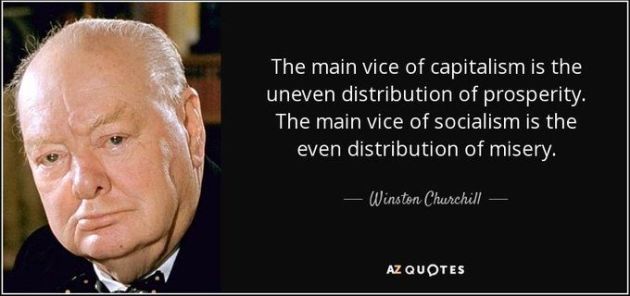
End of the day, the choice is between even distribution of poverty and uneven distribution of prosperity. Choose wisely. There’s no Utopia in which there’s even distribution of prosperity.
FOOTNOTES:
- J6P stands for Joe Six Pack or Jane Six Pack i.e. Common Man or Common Woman respectively.
- Students are not free to pursue engineering in China. The government forces most students to join vocational training colleges (the equivalent of India’s ITI), thus condemning them to a lifetime of lack of upward mobility. To some extent, this is also true in Germany, where Fachhochschule students comfortably outnumber Technische Universität students.