Suppose they say “We scan containers all the way from Hong Kong through to Port Elizabeth“.
Then you learn that they scan 2% of all container traffic on this route.
Would you call the above statement is misleading?
Many people would.
But should they?
I’d a few months gap between the end of my FYJC (11th grade) and the start of my IIT (B.Tech). I spent the time reading about fuzzy logic, cybernetics, information theory, etc. (see footnote 1)
I still remember the example used in one of those books to illustrate fuzzy logic.
Suppose you see a heap of sand. You call it a heap of sand. Suppose you remove one grain of sand from it. What do you call the rest? You still call it a heap of sand.
Supose you remove one more grain of sand. You still call it a heap of sand.
Rinse and repeat.
If you notice, the heap of sand has progresively undergone considerable change in quantitative terms but qualitatively it remains a heap of sand.
Likewise, I’d argue that the above statement is not misleading as long as the port authority scans a “few” containers. It’s certainly not misleading since it scans 2% of the container traffic. In other words, the above statement is kosher because it never claimed “We scan 100% of containers…”.
Some may argue that the original statement is the height of obfuscation. Maybe it is, maybe it isn’t, I’ll leave it to readers to decide.
There are broadly two GTM themes for Enterprise AI:
(A) AI does the same work in 1/10th the time.
(B) AI does 10 times the work in the same time.
In the first framing, AI causes fears of job losses i.e. dystopia.
In the second framing, AI triggers feelings of abundance i.e. utopia.
AI is not the first gamechanging technology with the above framing. I’ve come across – even created – it for many other transformative technologies in my 40 years of selling B2B technology.
My first exposure to this framing was with supermini computer in the late 1980s when many vendors launched server-grade computers, but with multiple CPUs. Some vendors used indigenous designs developed by their inhouse R&D. Some others were Indian companies with technical collaboration with American computer manufacturers. Still others were Indian subsidiaries of American and British companies. There’s a popular notion that the liberalization of 1991 led to a deluge of foreign computer manufacturers, which killed Indian computer manufacturing. Nothing could be farther from the truth (see footnote 2). But I digress.
Vendor H and Vendor W were the market leaders in the supermini computer category.
Vendor H’s supermini computer used a tightly-coupled architecture that split a single workload and ran it across many CPUs, thereby completing the job in less time, so it lent itself to GTM-A.
Vendor W’s supermini computer used a loosely-coupled architecture that let multiple workloads to be run simultaneously across many CPUs, thereby doing more jobs in the same time i.e. GTM-B.
Both products were equally popular in the market, each with 35% market share, with the remaining 30% shared by half a dozen other brands of supermini computers. So both framings worked, there’s no one right answer or holy grail for supermini computer architecture, it all depended on the usage scenario.
Cue to AI and the present day. In my blog post entitled ChatGPT: Navigating the Peaks and Troughs Of Gartner Hype Cycle, I’d given one example for each of the two framings of Enterprise AI.
My go-to example for GTM-B was the following:
Right now, only 2% of containers are reportedly scanned enroute source to destination harbors due to lack of resources. By using GenAI, port authorities might be able to scan 100% of ocean traffic, which will help increase the safety of crossborder shipments.
I’m happy to inform that somebody is plucking this low hanging fruit!
The government is working towards a phased system that could eventually scan every consignment entering the country.
– AI, Tech to Scan Cargo Without Disrupting Trade: CBIC Chairman
The operating term is “every consignment” i.e. 100% of containers.
When the system is operational, CBIC can declare “We scan consignments entering the country” and I wouldn’t need to use fuzzy logic to argue that it’s not misleading!
Talking about the books I’d read in the months between FYJC and IIT, one of them covered computational linguistics, a field of maths / language that undergirds ChatGPT, Claude and other LLMs that are all the rage now.
We keep hearing that “LLM predicts the next character aka token based on the previous token”.
The prediction is made via transformer technology and involves looking up a so-called n-gram, which shows the probability of occurence of a letter (1-gram) or letter pair (2-gram) or letter triad (3-gram) in a language.
I asked ChatGPT and Gemini for pictures of 1-gram and 2-gram, i.e. matrix of probabilities of occurence of the letters A, B, C,…Z and letter pairs AA, AB, AC,…, QU,…, ZZ in English language text.
I got the following image from ChatGPT.
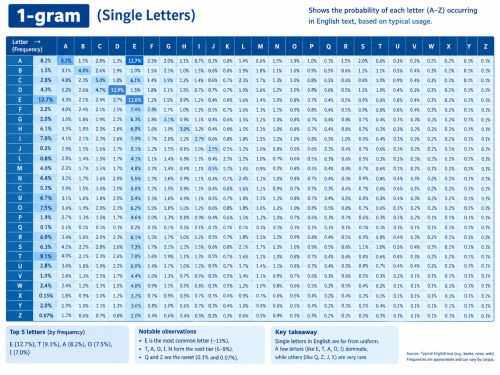
There are many things wrong with it:
- It has mislabeled the chart as 1-gram even though it shows both 1- and 2-grams.
- It has missed the letter ‘K’ on the vertical axis!
- Many rows fail to add up to 1.00 (i.e. 100%).
Gemini did not give me any image(s) for either 1- or 2-gram. But it gave me complete raw data for 1-gram and partial raw data for 2-gram, from which I built out the following matrixes.
1-gram:

2-gram:
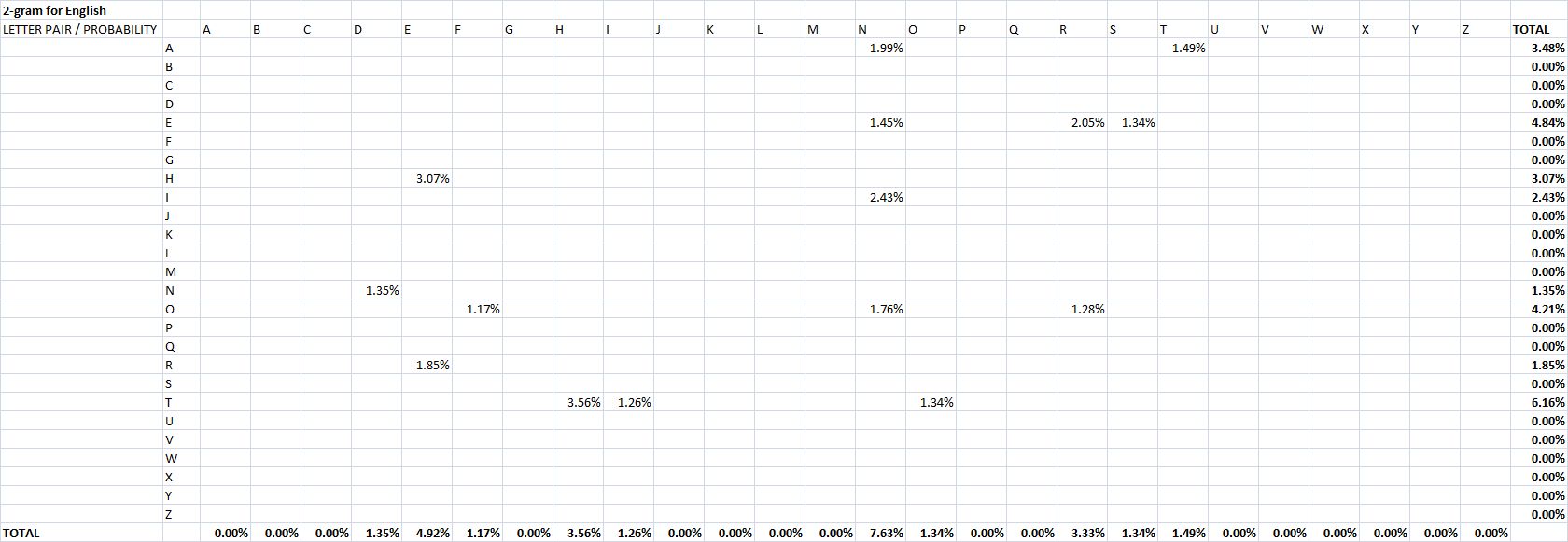
Here are two fun facts about the English n-gram:
- 1-gram: ‘E’ is the most common letter in English and has the highest probability of occurence of a single character in any random text in the English language (12.70%). Put more simply, nearly 13 out of every 100 characters in English text is an ‘E’.
- 2-gram: U follows Q in almost 100% of words in English, so the pair QU has a probability of near-100% and all other Q-pairs like QA, QB, …, QZ have a probability of near-zero.
One of the earliest real-life uses of n-gram was during World War II, when troops on the frontline had to send reports to their command HQ via telegram / telex machine. Telephone lines were very slow. Every character saved from transmission helped speed up the communication. So modems had algorithms that compressed the source text using the 2-gram, so instead of sending the full word “QUEUE”, they would only send the string “Q_E_E” across the channel, and the modem on the receiving side would look up the same 2-gram to decompress the string “Q_E_E” to “QUEUE”.
This achieved 40% savings in bandwidth i.e. compression.
The reverse of 40% compression rate is called “redundancy”. Loosely speaking, lower the redundancy, higher the “energy efficiency” of a language.
English has around 70% redundancy.
2D crosswords are possible in many languages. But 3D crosswords are possible only in languages with <50% redundancy. Tamil and Sanskrit are apparently the only two languages in the world that make the cut.
I stumbled on to this knowledge 45 years ago and never encountered it afterwards until it became common knowledge when ChatGPT was launched four years ago. I was extremely thrilled to find out that even Comp. Science graduates from IITB and other colleges hadn’t heard about the concepts of n-gram and language redundancy until 2022 whereas I knew about them in 1980.
FOOTNOTES:
- B.Tech was a five year program (following 12th grade) at IIT Bombay until and including my batch (1980-1985). By then, other engineering colleges had already switched to four years. To help students of my batch to maintain parity with our school and junior college batchmates, IIT permitted us to take JEE after 11th grade. It’s not only me, even the JEE AIR 1 of my batch (Pandurang Nayak) was from 11th grade.
- At the time of liberalization, I used to work in a company that was regarded as a top manufacturer of computer hardware in India. Well before 1991, our management had decided to softpedal hardware manufacturing because it had very low margins and get into software / services because it had very high margins and way higher TAM. The arrival of IBM, HP, Dell, etc. after the liberalization of 1991 did not affect this company’s decision to exit hardware manufacturing altogether a couple of years later. tl;dr: It was a capital allocation decision, not an issue of inability to survive foreign competition.
- As for the overall market, I tend to believe Indian manufacturers have a few DNA problems: (i) Poor finish / workmanship (ii) Lack of attention to details (iii) Lack of business savvy. These will keep them behind in manufacturing, with or without competition from foreign manufacturers. Even today, there’s a big difference in first impression between a TATA / M&M / Maruti Suzuki car on the one side and a Toyota / Nissan / Ford car on the other. Products manufactured by Indian companies have a distinctly inferior workmanship compared to products of foreign companies manufactured in India. Ergo, as I keep saying, the goals of Make In India will be achieved way more rapidly by getting foreign companies to manufacture in India than Indian companies. While Industrial Policy was abandoned in 1991, financial policy gave a fillip to Indian manufacturers by slapping very high customs duties on foreign goods, not sure why Indian manufacturers didn’t leverage that to their advantage.