In SaaSpocalypse Now – Part 1, we saw five updates on the SaaSpocalypse narrative:
- SaaSpocalypse shaaspocalypse
- Discounts ahoy
- AI hits point SAAS hard
- AI does more than coding
- SaaS can do AI better than AI can do software
In this second part, we will cover five more.
6. New twist in the SaaSpocalypse tale
The SaaSpocalypse narrative has so far posited that AI BUILD will replace SAAS / COTS BUY.
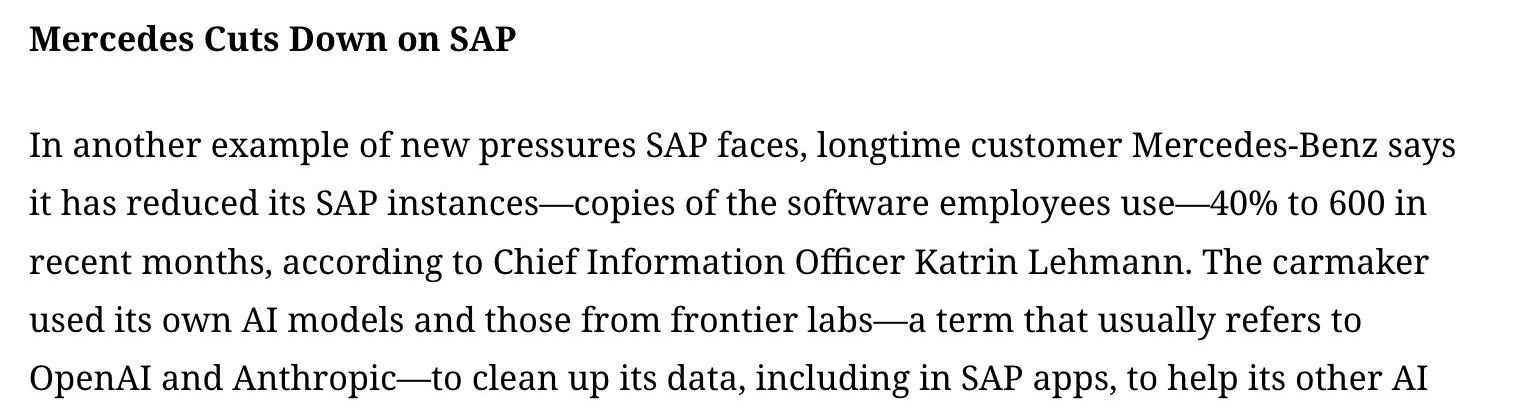
But there’s a new twist in the tale. Large companies are using AI not to build SAAS / COTS equivalents inhouse but to prune their existing SAAS / COTS estates. To take an example, the German automobile manufacturer Mercedes-Benz used OpenAI and Anthropic LLMs to slash the number of its SAP instances from 1000 to 600.
If this trend gains traction, it will cause a major loss of revenues for SaaS companies.
On a side note, I got a jolt when I read those numbers. Back in the day, when I used to sell a competing ERP product, SAP used to claim that R/3 was so powerful, versatile, and robust that just a single instance of it was enough to run a large company comprising multiple SBUs – or even a conglomerate comprising multiple companies during the last month of its fiscal year!
7. Cybersecurity apocalypse
The threat of AI to security software seems particularly severe and credible.
According to the popular narrative, the advanced models of LLMs from OpenAI and Anthropic will be able to scan a company’s IT landscape, find vulnerabilities, recommend fixes, and apply them automatically. Many cybersecurity software customers seem to be buying into this narrative. For example, Conga, per The Information’s interview with the contract software firm’s chief information security officer Susanne Senoff.
I’m not surprised by this. Cybersecurity software has massive pain areas and is ripe for disruption.
In my 40 years of selling enterprise software, the number of security software categories – wholesale categories, not just products within a category – has exploded from 1-2 then to 20-30 now. Back in the day, there was antivirus software on desktops and firewalls for the enterprise network. Now there’s antivirus, firewall, FWaaS, NAC, SIEM, CASB, SWG, and so on. Some of them protect endpoints, others safeguard enterprise networks, private and public clouds. Each product secures just a tiny part of the enterprise’s IT landscape but costs a bomb. As a result, the current breed of security software is expensive, difficult to implement and bought only by large corporations.
If AI really works as advertised and finds vulnerabilities and patches systems automatically, I see it wiping out the entire cybersecurity software category and democratizing access to security for companies of all shapes and sizes.
8. SaaS pushback
Needless to say, SaaS vendors are not taking the threat of SaaSpocalypse lying down.
Some are levying a fees for enabling agentic access e.g. (i) Microsoft, which recently announced that customers of Office365 and its other enterprise software products will need to purchase seats for both human users and AI Agents (ii) HubSpot, which recently announced plans to charge customers extra if they wanted external agentic AI access to its CRM database.
Others are blocking API access to unauthorized AI agents e.g. SAP, which does ot allow OpenClaw AI agents to access its BAPI.
These pushbacks remind me of the SAP v. Microsoft and SAP v. Diageo cases from the 1990s and oughties respectively.
9. Skyrocketing token costs
AI vendors recently switched from seat-based subscriptions to usage-based pricing. (Software Pricing Partners has released a comprehensive list of pricing models for AI spanning AI Credits, Token Pricing, and so on.)
One immediate effect of the change in pricing model is skyrocketing of AI token costs for end users. Uber CTO reported that his company blew through the entire 2026 token budget in the first four months of the year itself. According to The Information, Uber isn’t alone:
Many other firms are struggling to navigate Anthropic’s shift to charging customers based on token consumption, which has made it harder for them to gauge costs in advance.
Some companies report firing their AI Agent army and rehiring human workers!
If AI gets expensive, that may deter companies from SAAS Repatriation, especially given the other risks associated with the move.
10. SaaS is bracing for SaaSpocalypse
While it’s maintaining a brave front and pushing back on the SaaSpocalypse narrative on the one hand, the SaaS industry is secretly admitting the threat of AI and bracing itself for the threat of apocalypse on the other.
SaaS giant Salesforce has recently started isolating seat-based revenue into a new bucket. I see this as a hedge against the fall of its SAAS products by highlighting the growth of its AI products.
I’m not alone. Vernon Keenan, a software industry analyst who covers Salesforce, sees this as a “nod to the SaaSpocalypse threat”.
There are a lot of moving parts, some indicating that SaaSpocalypse is imminent and the others downplaying the impact of AI on SaaS.
Between the first and second parts of this two-part blog post, we’ve seen 10 factors. I judged each factor on its propensity for SaaSpocalypse. This is what I got:
| SLNO. | FACTOR | FOR / AGAINST SAASPOCALYPSE |
|---|---|---|
| 1 | SaaSpocalypse shaaspocalypse | FOR |
| 2 | Discounts ahoy | NEUTRAL |
| 3 | AI hits point SAAS hard | FOR |
| 4 | AI does more than coding | FOR |
| 5 | SaaS can do AI better than AI can do software | FOR |
| 6 | New twist in the SaaSpocalypse tale | FOR |
| 7 | Cybersecurity apocalypse | FOR |
| 8 | SaaS pushback | NEUTRAL |
| 9 | Skyrocketing token costs | AGAINST |
| 10 | SaaS is bracing for SaaSpocalypse | FOR |
Here’s the final tally:
FOR SaaSpocalypse: 7
AGAINST SaaSpocalypse: 1
NEUTRAL: 2
TOTAL: 10
Although the tally overwhelmingly forecasts SaaSpocalypse, I think it’s still early days. To quote Martin Peers:
The impact of AI on existing software firms will take several years to play out, and some firms will come out of the transition better than others.
In other words, only time will tell!
PS: Given my rudimentary HTML skills, I’ve always found it difficult to make tables on WordPress. Before ChatGPT, I’d try to code them by myself. I’ve also tried some table plugins but didn’t dig the shortcode concept used by them. After ChatGPT, I started prompting ChatGPT for HTML code for tables of varying sizes for different blog posts. This worked reasonably well but it still took some manual tinkering from one post to another. I thought of another hack this time: I easily made the above table in Microsoft Word, uploaded the DOC file to ChatGPT, and asked for the HTML code for an identical table in WordPress. ChatGPT gave me the code, which I pasted blindly in the “Code” view of WordPress editor without making a single change. The table you see above is the result. Mission accomplished!
RELEVANT READING: