In a series of posts published on this blog well before the term SaaSpocalypse was coined, I predicted that AI will kill many SAAS companies (see the RELEVANT READING section at the end of this post).
Here’s a quick recap of those posts:
“SaaS Repatriation” is the replacement of SaaS applications with bespoke software built in-house using AI coding agents like ChatGPT, GitHub Copilot, and Cursor. The technology rekindles the classical BUILD versus BUY debate. In the first phase of enterprise software, companies built their software inhouse. In the next phase, they moved from the BUILD custom development default to BUY COTS / SAAS packaged software best practice.
AI coding tools have made the BUILD option viable again by dramatically reducing development effort and time-to-market of bespoke software. So the pendulum has begun swinging to the other side.
SaaS Repatriation does not posture that enterprises will rebuild their entire SaaS functionality inhouse. Instead, it relies on the empirical observation that companies typically use only a small fraction of the functionality of the SaaS that they pay for e.g. just 29 out of 15,000 functions (0.2%) in the case of Bloomberg Terminal. Accordingly, SaaS Repatriation focuses on enabling companies to recreate just the subset of features that they actually use – faster, cheaper and arguably better.
SaaS applications with narrow functionality are easier to replicate using AI-generated code. Large integrated suites not so much. Therefore, AI poses existential threat to point SaaS solutions rather than large integrated suites.
Even if SaaS Repatriation never goes mainstream, the mere existence of a credible BUILD alternative strengthens customers’ negotiating position and helps enterprises to extract deep discounts from their incumbent SaaS vendors.
Since then there have been many developments on this topic.
I’ll cover some of them in post and the others in a follow-on post.
1. SaaSpocalypse shaaspocalypse
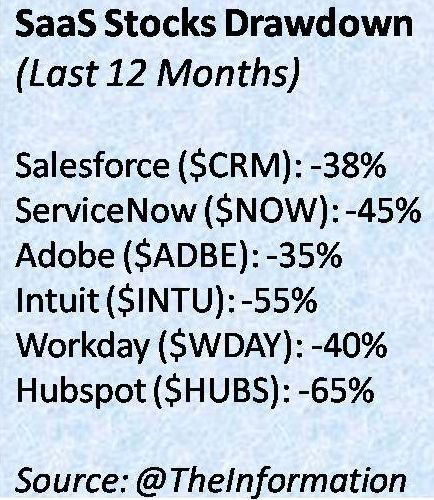 SaaS vendors pooh-pooh the notion of SaaSpocalypse and point to their robust earnings numbers as proof that SaaS is not dying.
However, as I highlighted in “Will AI Kill SaaS?” Is The Wrong Question, SaaSpocalypse is not about revenues and profits (PLBS) but valuation (MCAP). On that count, AI has definitely hit SaaS hard, as the severe drawdown in SaaS stock prices over the last twelve months (TTM) shows.
2. Discounts ahoy
As I predicted, many SaaS customers are extracting deep discounts from their vendors at the time of renewal. Besides, they’re refusing to sign long term contracts with SaaS vendors, confident that AI will enable them to ditch their SaaS sooner or later.
3. AI hits point SAAS hard
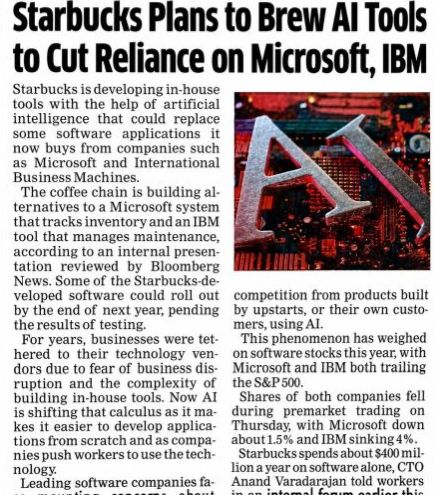 AI BUILD has indeed hit point SAAS solutions hard. Here are a few well known examples:
- In an OddLots podcast, Marco Argenti, the CIO and CAIO of Goldman Sachs confirmed that the world’s largest investment bank has terminated SAAS contracts worth “millions of dollars”.
- Starbucks is using AI BUILD to replace a Microsoft inventory tracking system and an IBM maintenance system, as reported by Bloomberg recently.
- Sanofi is using its own in-house AI agent developed with Claude Code to reduce usage of ServiceNow IT management software (Source: The Information “Applied AI” newsletter).
- Utila, a young Israeli startup that sells software for enterprises to manage their cryptocurrencies, used AI to get rid of 10 point solutions from small software providers such as Clay and Vendelux that automated narrow business processes such as tracking prospect data, sending emails to prospective clients, creating and managing marketing campaigns and events, and preparing for sales meetings (Source: The Information “Applied AI” newsletter).
- US Department of Agriculture replaced Salesforce with Enterprise AI software C3 for its correspondence management use case. Click here for more details.
4. AI does more than coding
SaaS vendors point to vibe coding tools and say that software development is not only about coding but also involves testing, deployment, etc., thereby suggesting that AI cannot kill SAAS.
While they’re right, they’re behaving like the proverbial ostrich burying its head in the sand.
Before AI vibe coding came along, software developers acted as though coding was the only activity in software and belittled business analysis, design, testing, devops, marketing, sales and other functions integral to the software business. They were helped in this pursuit – wittingly or unwittingly – by the misleading term “software development”: While the SDLC (Software Development Life Cycle) involves many stages other than coding, the omnibus term “software developer” created a false equivalence between the software developer role and the software development activity, and helped coders to brazenly claim credit for the entire software, overshadowing the contribution of designers, testers, marketers and others to a software business.
Now that AI vibe coding has gone mainstream, software developers have found God and are suddenly remembering that software business is not just about coding but involves design, testing, marketing, sales, etc. Well, everybody other than software developers knew that all along. While their memory is right, their pushback misses two important points:
- AI tools are no longer restricted to coding – by now there are AI tools for requirements, design, testing, devops and other stages of the SDLC.
- While SAP created highly paid SAP FICO consultant jobs, the accountants it replaced didn’t get those jobs. Likewise, most of the software developers displaced by AI vibe coding won’t get those design, testing, marketing and sales jobs. Lest they think that upskilling is the answer, they should Beware Of The “Upskill Or Die” Scam that was perpetrated during the last crisis to the IT Services industry caused by Digital Transformation (DX) wave in the late 2010s.
5. SaaS can do AI better than AI can do software
SaaS vendors assert that they have decades’ worth pristine data whereas LLMs are trained on near-junk quality data and accordingly claim that they can do AI better than AI vendors can do software. On the face of it, there’s some merit in this argument.
But I have two counterpoints.
Firstly, in my firsthand use of ChatGPT over the past three years, I’ve received good quality outputs most of the times. Even if it has ingested junk data, as SaaS maxis claim, genAI has done a great job of cleansing the stuff it trains on (or found some other way to produce gold from junk).
Secondly, AI is a major technology paradigm shift. Whatever few disruptions we’ve witnessed in the history of B2B technology have been caused by new entrants whose products were functionally inferior to those of the incumbent leaders e.g. When iPhone first came out, it didn’t support SMS forwarding, a feature that Nokia had for years before; the first version of Salesforce CRM (cloud) had a fraction of features of the incumbent CRM leader Siebel (COTS). If history is any guide, AI BUILD, which is based on one of the biggest technology paradigm shifts of our times, can kill SaaS even if it does not functionally match it.
To qualify as Disruptor, a product must be CHILL:
CH: Cheap.
I: Inferior quality.
LL: Low end target market.Ergo:
* Uber did not disrupt yellow cab
* iPhone did not disrupt smartphone / Nokia / BlackBerry— SKR (@s_ketharaman) May 31, 2021
In a follow-on post, I will cover five more takes on the SaaSpocalypse narrative.
Watch this space!
PS: Title H/T the Francis Ford Coppola classic movie Apocalypse Now.
RELEVANT READING: