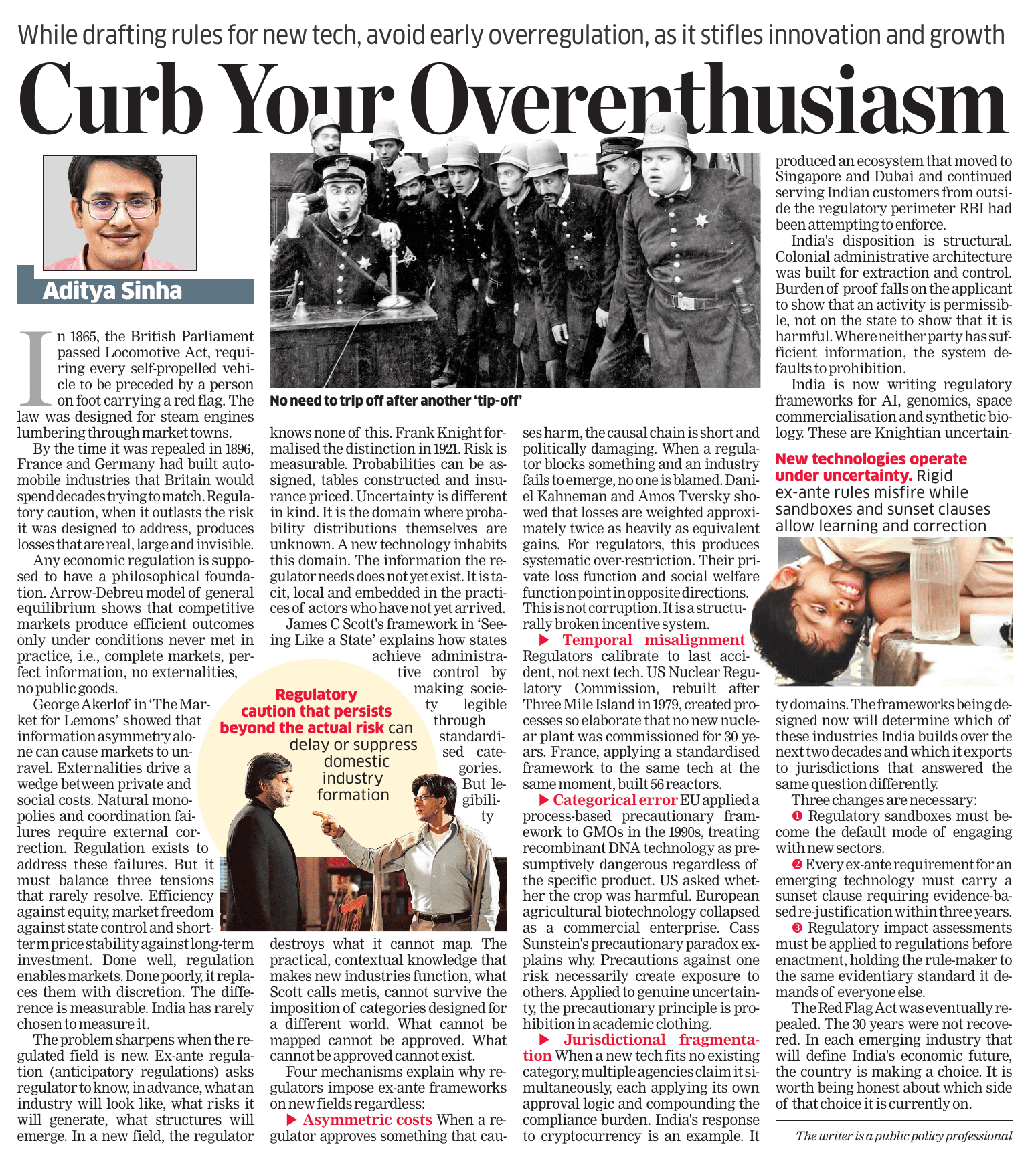
According to the popular narrative, India can’t make breakthrough innovations because of brain drain, low investments in R&D, billionaires more interested in making ice cream, and so on.
To those, let me add five more reasons.
- Overzealous regulation
- Scam syndrome
- Lack of talent
- Faux authenticity
- Extreme value-consciousness
Let’s unpack each one of them.
1. Overzealous regulation
 Compliance is “staying in the box”. Innovation is “going out of the box”. By definition, they’re pointed in opposite directions.
“Compliant innovation” is an oxymoron but regulators keep trying to enforce it via ex ante regulation.
This curbs innovation. To take an example, if all the extant rules on two factor authentication for online payments had applied to UPI ex ante, it’d have been as painful to make a UPI payment as an NEFT or IMPS payment, and UPI would’ve been dead on arrival.
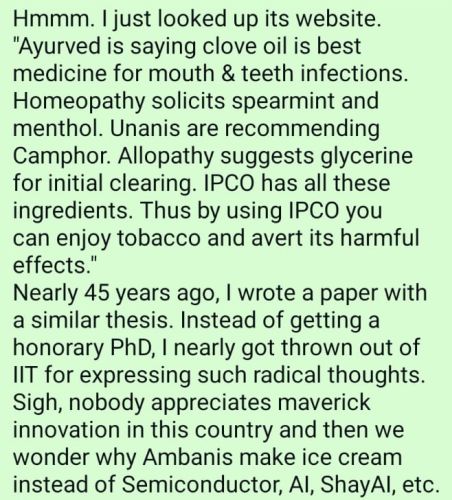
It’s not only me. A recent oped entitled Curb Your Enthusiasm in the Economic Times echoes my take.
Fans of ex ante regulation counter this by arguing that it takes time for ex post regulation to be enacted, by which time industry players could become “too big to be regulated“.
They’re not entirely wrong. In the absence of ex ante regulation, Epharmacy and Bikeshare followed the regulatory entrepreneurship playbook and leveraged regulatory gaps.
“Regulatory Gap” is something that lies in the twilight zone between “Not Legal” and “Not Illegal”, two terms that are interpreted by regulatory entrepreneurs thusly:
- “Not Legal” means there’s no law on it.
- “Not Illegal” means it does not violate any existing laws.
- “Not Illegal” does not mean “Legal” and “Not Legal” does not mean “Illegal”.
In other words, Regulatory Gap is something that’s neither permitted nor banned by law.
According to news reports, startups don’t have the required licenses for epharmacy and bikeshare despite operating them for over five years, and frequently get into tussles with pharma regulator and brick-and-mortar chemist shops, and transport regulators and auto rickshaw unions respectively, even to this day. But they’ve become unicorns and decacorns by now, which reflects the limitations of ex post regulation.
However, that’s not enough reason to be overzealous with regulation because ex ante regulation would’ve nipped these startups in the bud, cutting off the humongous value they created for their investors, founders, employees, and suppliers. In my opinion, regulators can curb the risk of these startups going rogue by conducting periodic reviews of their operations vis-a-vis shifting market conditions.
Thankfully, the Indian courts of law have reversed several overzealous regulatory actions e.g. CCI v. Amazon, SEBI v. NSE CoLo, CCI v. Grasim.
“Supreme Court scrapped ?202 CR penalty on Amazon and told CCI to refund the amount”.
Nice to see the courts quashing yet another case of overzealous regulation / enforcement. Just because innovation is not understood doesn’t mean it’s a scam.
SEBI v. Jane Street. NSE CoLo.— SKR (@s_ketharaman) July 18, 2026
2. Scam syndrome
Whenever a company does something new, the common Indian man or woman (henceforth J6P for Joe Six Pack or Jane Six Pack) rushes to diss it as marketing gimmick, dark pattern, scam or fraud – just because they don’t understand the new thing. They completely miss that, if something were fully clear to everyone and totally conformed with extant business practices, it wouldn’t be a breakthrough innovation in the first place.
UPI-AutoPay is a good example of this syndrome. Per RBI Reg eMandate, consumers can setup and cancel recurring UPI payments. Until the consumer cancels the mandate, the recurring payments run and the supplier continues to bill him or her. This is how subscriptions work all over the world but J6P insinuates scam. I pushed back as follows:
@s_ketharaman: Per RBI eMandate, consumer is empowered to turn off recurring payments, not supplier or regulator or PSP or payment scheme operator or automatically. It’s impossible to set up a UPI AutoPay mandate without entering a PIN, so parents can’t claim that their kids set it up accidentally. Parents let their children play with their mobile phone to get some free time, so it could be argued that they’ve deliberately not canceled UPI AutoPay so that they can enjoy more free time. Unless there’s evidence that the parents wanted to turn UPI-AutoPay but could not, there’s no need to assume that all consumers are damsels in distress and that all suppliers are rogues.
At the risk of sounding a bit harsh, I believe the average Indian suffers from the crab-in-the-bucket mentality and often dismisses others’ success as a scam.
3. Lack of talent
While blaming brain drain and the other usual suspects for lack of breakthrough innovations out of India, many Indians take talent for granted. For example:
India will never have a Nubank. Or a Revolut. Not because we lack the talent or the demand. Because the RBI doesn’t let a digital-only bank exist the way Brazil or the UK do. – Srinidhi Chari.
I’m not so sure about this tacit assumption.
Firstly, until India makes breakthrough innovations, this is a faux nationalistic claim bereft of evidence.
Secondly, India has tried to make homegrown versions of several products years after they’ve been launched abroad but has still not succeeded in its pursuits e.g. Indian Supercomputer, Indian GPS, Indian Tablet, Indian App Store, Indian LLM, etc. Scarcity of talent has to play some role in those failures?
Thirdly, to those who point to breakthrough innovations made by people of Indian origin in USA, well, people from all countries, including Germany and Japan, tend to do better in USA than in their home countries, so the American business milieu – not their native talent – explains their superlative performance in USA.
4. Faux authenticity
If this heading sounds like an oxymoron, that’s intentional.
I recently saw an ad for Paithani Shorts.
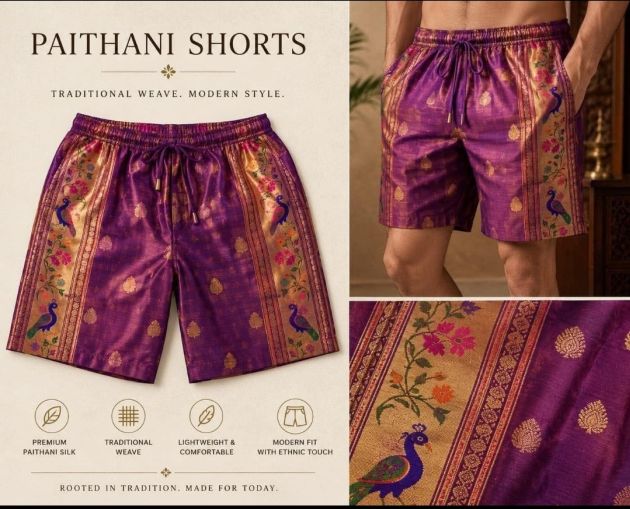
Many people commented that it desecrated the brand.
For the uninitiated, paithani is a variety of sari, named after the Paithan in Chhatrapati Sambhajinagar district from the state of Maharashtra in India where the sari was first made by hand. Present day Yeola, a town in Nashik, Maharashtra is the largest manufacturer of paithani. The art form is characterised by selvedges of an oblique square design, and a padar with a peacock design.
Since paithani is a sari, making shorts out of the material goes against the grain of the art. However dismissing it as desecration is missing the big picture.
Historically, tradition has spread by adoption.
- Traditional pizza made in Italy is thin crust. But Pizza Hut adapted it for the global market by making it deep pan. The rest is history.
- American companies distribute doormats printed with their logo as gifts to their customers since it aids in brand recall as people stamp on it day in day out.
In my opinion, variants that boost adoption without egregiously breaching cultural norms are kosher. Accordingly, shorts is a permissible variant for paithani but doormat is not.
Shorts are popular all over the world. Sari is not. Paithani cannot scale worldwide if it’s restricted to saris. To that extent, paithani shorts is an acceptable way to scale the art form globally. Viewing it as a desecration is faux authentic behavior that will hamper the intrinsic global appeal of the art form.
Unfortunately, many Indians believe they can keep tradition locked in a box labeled AUTHENTIC TRADITION in some unknown place, and the whole world will stand in a line to come see that box. They simply fail to understand that things don’t work like that in today’s hyper-competitive world.
Then, when somebody else adapts their tradition in a different form and takes it global, the same Indians will outrage that others have copied / stolen their tradition. On top of that, they will whine that the world accepts it when others shill it but not when they do it. This is clearly defeatist attitude.
5. Extreme value-consciousness
Indians are reputed to be extremely value-conscious.
Many people think that this consumer behavior trait will help Indian companies to produce better software products than other countries e.g.
Kapil Solanki: Indians don’t pay for AI. That’s becoming the biggest excuse AI founders use when their product doesn’t work. India is one of the fastest AI-adopting markets in the world. The real problem? Indian buyers reject hype faster than most countries. They don’t care about AI-powered. They care about one thing: Show me what this saves or earns me. Indian users are not anti-AI. They’re anti-wasting-money. And honestly, that mindset might force companies to build better AI products than the rest of the world. What do you think?
Unfortunately, it won’t – the technology business often works in the opposite fashion.
New technologies require paying customers who tolerate immature products, bugs, missing features and uncertain ROI. They buy technology for the sake of technology because they covet novelty, coolness, prestige, experimentation or strategic advantage. They routinely overpay relative to objective value and without consideration for ROI. Such customers are typically a part of the Innovators and Early Adopters cohorts of the Technology Adoption Life Cycle.
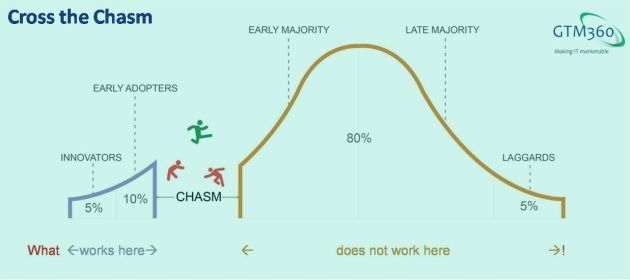
Historically, tech vendors have found a critical mass of such customers in USA. Correlation is not causation but there’s no escaping the fact that an overwhelming majority of breakthrough innovations and new product categories have originated in USA in our entire lifetimes (and before).
Now come to a market like India. It lacks a critical mass of Innovators and Early Adopters required by a vendor to launch any new technology in it.
Consequently, local technology vendors struggle to find enough launch customers to refine their offerings and survive long enough to reach the mainstream market (or go West right from day one). As a result, such a market cannot produce any new technology.
On the other hand, it has a fairly large number of buyers who will buy products with proven ROI. They belong to the Early Majority and Late Majority cohorts of the TALC.
As a result, such a market tends to be a consumer rather than producer of disruptive technologies, importing them after they have already crossed the early stages of adoption elsewhere. We’ve seen this happen repeatedly with all technologies in the past. I predict that we’ll see it with AI as well.
As in the previous gamechanging technologies, India is poised to gain more from being customer than producer of AI. Producer gains Market Cap. Customer gains business benefits that drive revenue / profit and GDP. https://t.co/JnqtUdEh2o
— SKR (@s_ketharaman) July 8, 2026
My prediction has aged well! India is apparently the second largest enterprise market for Anthropic in the world. Click here and here for receipts.
Incidentally, the second link goes to my convo with ChatGPT. I felt that, like that of all B2B technologies, Anthropic’s country-wise market size will track a country’s GDP rank. India is the sixth largest economy in the world. I excluded China since Anthropic is banned there. So I could believe that India would be among the Top 5 markets for Anthropic but rank #2 seemed like a tall claim. I quizzed ChatGPT about this. It made a very solid counterpoint:
The reason GDP is a poor predictor here is that Claude’s customer base is not “all enterprises.” It is disproportionately software developers, IT services firms, AI startups, Global Capability Centres (GCCs), and engineering organizations. India happens to be extraordinarily strong in exactly these segments. Anthropic’s enterprise seats don’t come from steel mills or automobile factories. They come from organizations with thousands of software engineers. India has them, Germany and Japan don’t.
I thought this was an excellent show of critical thinking by ChatGPT. Although I know from a previous experience that ChatGPT will not agree with me.
The above reasons explain why India has not produced any breakthrough innovations.
That said, that’s true only for technology innovation.
As I’ve said countless times, innovation can be found in many other areas like product, distribution and business model. India can proudly boast of many such innovations. See my blog post entitled Innovation Is Not Invention for a few examples.
PS: In case the aforementioned op-ed titled Curb Your Overenthusiasm in Economic Times is paywalled, cf. following exhibit.