This page carries a summary of views of different parties on this question.
1. Money Stuff: Jane Street’s Indian Options Trade Was Too Good by @matt_levine, 7 July 2025 and later: Arbitrage.
Last year, Jane Street Group sued Millennium Management for allegedly stealing its secret trade ideas. Jane Street had employed a couple of traders who discovered a trading strategy in the [redacted] market. Jane Street did some initial testing and found results that were “counterintuitive, unexpected, and initially met with significant skepticism and incredulity internally at Jane Street”: It made so much money that everyone thought it was a mistake. Jane Street started running the strategy in the [redacted] market and made a lot of money. Eventually the traders left for Millennium, and then Millennium allegedly started running the same strategy, eating into Jane Street’s incredible profits.
In its lawsuit, Jane Street did not describe the strategy, or even name the [redacted] market in which it was operating, because “even identifying the country involved would lead to others ‘picking apart’ the details.” But in a court hearing, Millennium’s lawyers repeatedly said that the strategy involved options trades in India, “at multiple points apologizing to the judge for doing so.” Oops! Oh well.
…
If you are a national securities regulator and you learn that a big international firm is making unbelievable amounts of money in your markets and keeping it secret, that doesn’t sound like good news for you.
…
Here is the order, which says that SEBI started looking into Jane Street after reading about the Millennium lawsuit in the papers. Of course it did.
…
The order focuses on Jane Street’s trading on one day, Friday, Jan. 17, 2024, an expiration date for the then-popular weekly cash-settled options on the Nifty Bank index.[1] Roughly 103 trillion rupees’ worth of those options traded that day,[2] 353 times the trading volume of the 12 actual bank stocks that make up the index.
Two points here:
- That’s weird!
- Just from that paragraph you should know exactly what Jane Street is accused of doing.
So, first: It’s weird to have an options market that is much bigger than the underlying stock market.
…
But there is also a structural story: Compared to other big markets, it is harder to get leverage on cash stock positions or futures in India, or to sell stocks short.[3] Lots of leveraged and long/short trading strategies are harder to do in India, but options — which offer a lot of leverage — are a decent substitute. This suggests two things. First, some trading strategies that would be implemented using stocks in the US could be implemented using options in India. Second, some trading strategies that have to be implemented using stocks — like arbitraging options versus the underlying stocks — are harder to do in India, so some arbitrages won’t close and some spreads will be wider.
…
Indian options trade much more liquidly than Indian stocks, but Indian options trade and settle based on the prices of Indian stocks. If you can move the stock prices, that mechanically moves the option prices. But the options are easier to trade (they are liquid), while the stock prices are easier to move (they are illiquid).
…
There were call options on the index, bets that it would close above a certain price: For instance, a call option with a strike price of 47,000 would pay off zero if the index closed below 47,000, or 1 rupee per point that the index closed above 47,000. (The options are cash settled: You don’t get delivery of any stock; you just get cash based on the closing price.) And there were put options, bets that it would close below a certain price: A put option with a strike price of 47,000 would pay off zero if the index closed above 47,000, or 1 rupee per point that it closed below 47,000.
…
But the actual underlying stocks trade much less than the options do. So, schematically, you can buy 100 million rupees’ worth of call options, betting that the stock will go up, without moving prices too much. And then you can buy 10 million rupees’ worth of the 12 underlying bank stocks, but because those stocks are pretty illiquid, your buying will move prices up.
…
This is a pretty intuitive story, but there is a problem with it.
The intuitive story here is: By buying in the (illiquid) cash market, Jane Street was pushing up the price of the index, which pushed up the prices of index options, which allowed it to sell much more in the (liquid) options market and make a huge but manipulative profit.
The problem with this story is that the options went down.
…
Retail investors were paying more for stock exposure via options than institutions were paying to buy the actual underlying stocks.
…
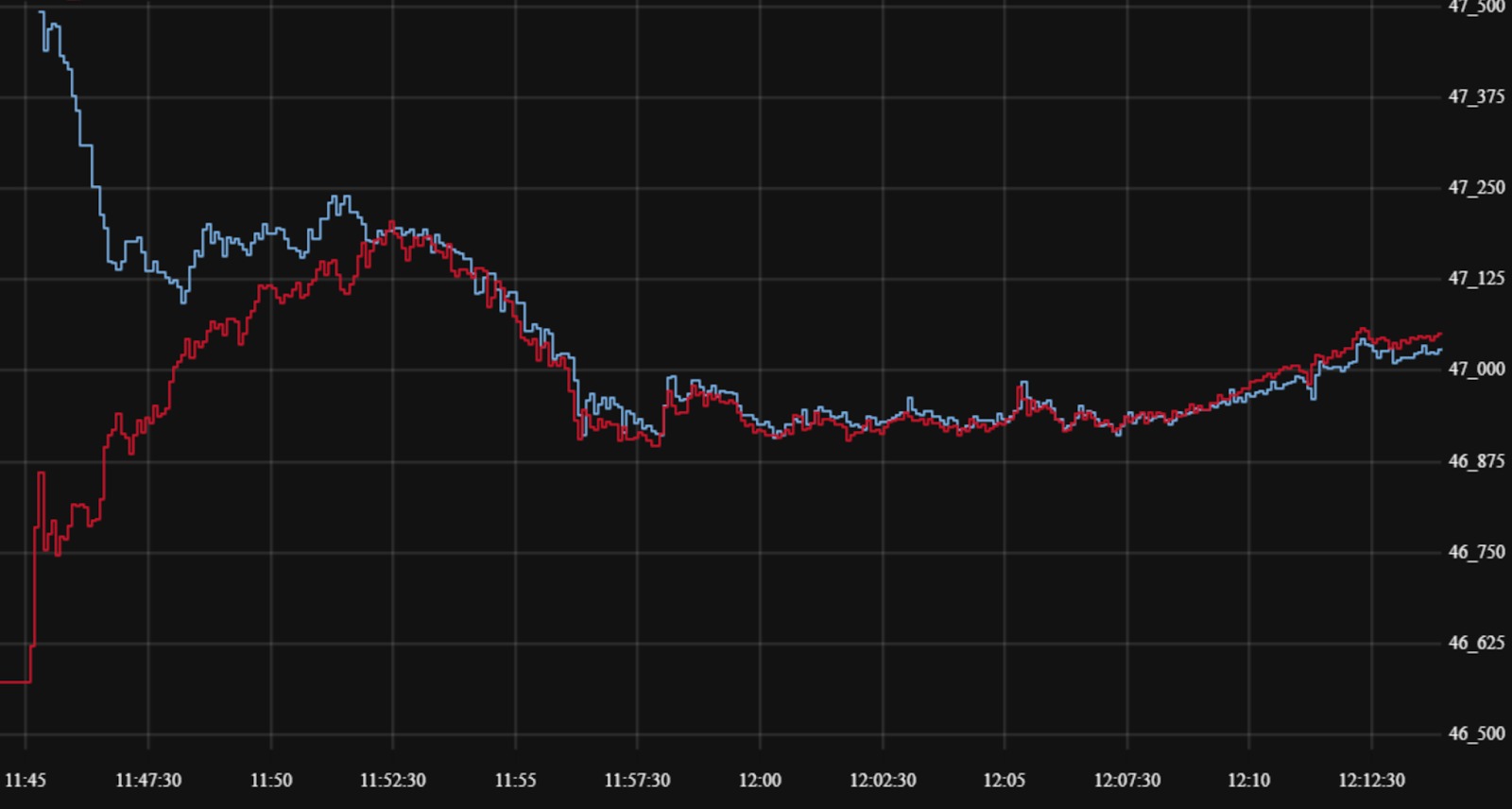
By 9:22 a.m., the premium had come down. At that time, according to SEBI, options implied a price for the index of about 47,187,[6] versus 47,176.97 for the actual index, a premium of about 0.02%. And this was below the options-implied index price at 9:15 a.m. As Jane Street was buying the underlying stocks, “temporarily pushing up or lending considerable support to the BANKNIFTY index,” the prices of options on that index were going down.
This is a very different story from the one SEBI tells. This does not look like manipulation; it looks like arbitrage.
…
I suppose the main point here is that, in many cases, “legitimately doing an arbitrage trade” and “trading in one market to manipulate prices in another market” look pretty similar. Either way, you are trading the opposite way, buying stock in the stock market and selling it in the options market or vice versa. The difference can be subtle, and I often joke that the difference between legitimate trading and manipulation is whether you send your colleagues an email saying “lol I sure manipulated that market.”
…
But it also made a ton of money? You can see how all of this might be “counterintuitive, unexpected, and initially met with significant skepticism and incredulity.” The story here is something like “Indian options were so popular, and so hard to arbitrage, that Jane Street could make billions of dollars just moving them to their correct prices.” That story should be annoying to SEBI too, even if it’s not Jane Street’s fault.
…
But more generally, it is a structural problem when a small illiquid underlying market sets the prices for a large liquid derivative market. It’s too easy to make a lot of money in the derivatives market by spending a little money in the underlying market.
2. Economic Times, The Morning Brief Podcast, Nightmare on Jane Street, 8 July 2025: If market manipulation, only by intensity and scale.
Indian securities laws permit the market maker construct and allows traders to take opposite positions between cash and derivatives market. Jane Street’s actions are permitted under Indian law.
SEBI’s interim order does not have evidence like “you send your colleagues an email saying “lol I sure manipulated that market.””. (SEC’s orders in many similar cases do.)
But the law is indexed on intent. SEBI claims Jane Street had intent to manipulate markets. Jane Street counters that by saying its trades were carried out by algorithms, which don’t have have any intent either way.
SEBI does not have a stellar track record of winning cases.
This will go to Securities Appellate Tribunal and, depending on the outcome there, may go to High Court or even Supreme Court.
3. Alexandander Gerko, CEO XTX Markets: Market manipulation.
(Cited by @matt_levine)
Alleged activity is clearly illegal in any country that has a financial regulator. Actually criminal in USA ( think jail time).
Cf. ChatGPT.
4. Andrew Peretti: Market structure responsible.
(Cited by @matt_levine)
The reason Jane’s Street strategy was ostensibly so effective is due to the discrepancy between cash market and options volume. In essence, the alleged manipulation is facilitated by the volume mismatch between the two markets.
5. Investment Banker 1: Gray area.
Life is not white and black – it has shades of gray.
6. ET Prime, Economic Times, 9 July 2025: Not illegal.
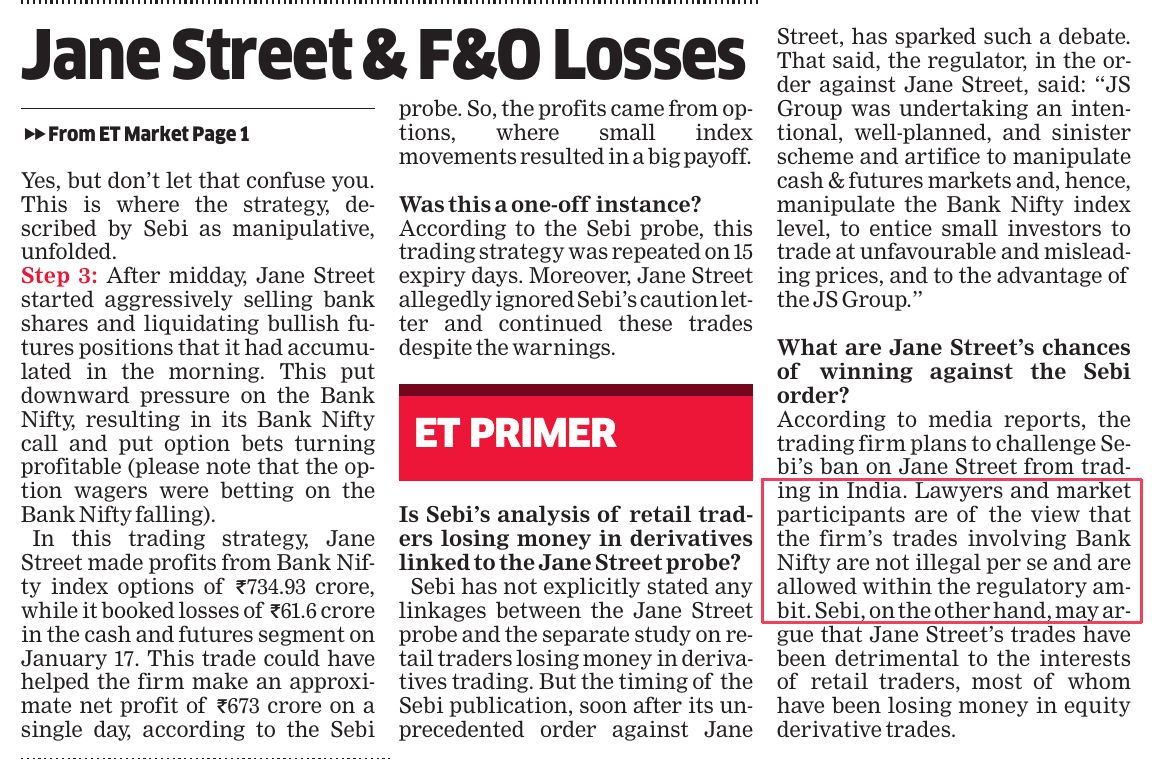
Lawyers and market participants are of the view that the firm’s trades involving Bank Nifty are not illegal per se and are allowed within the regulatory ambit.
7. Jane Street: Misunderstanding of standard hedging practices.
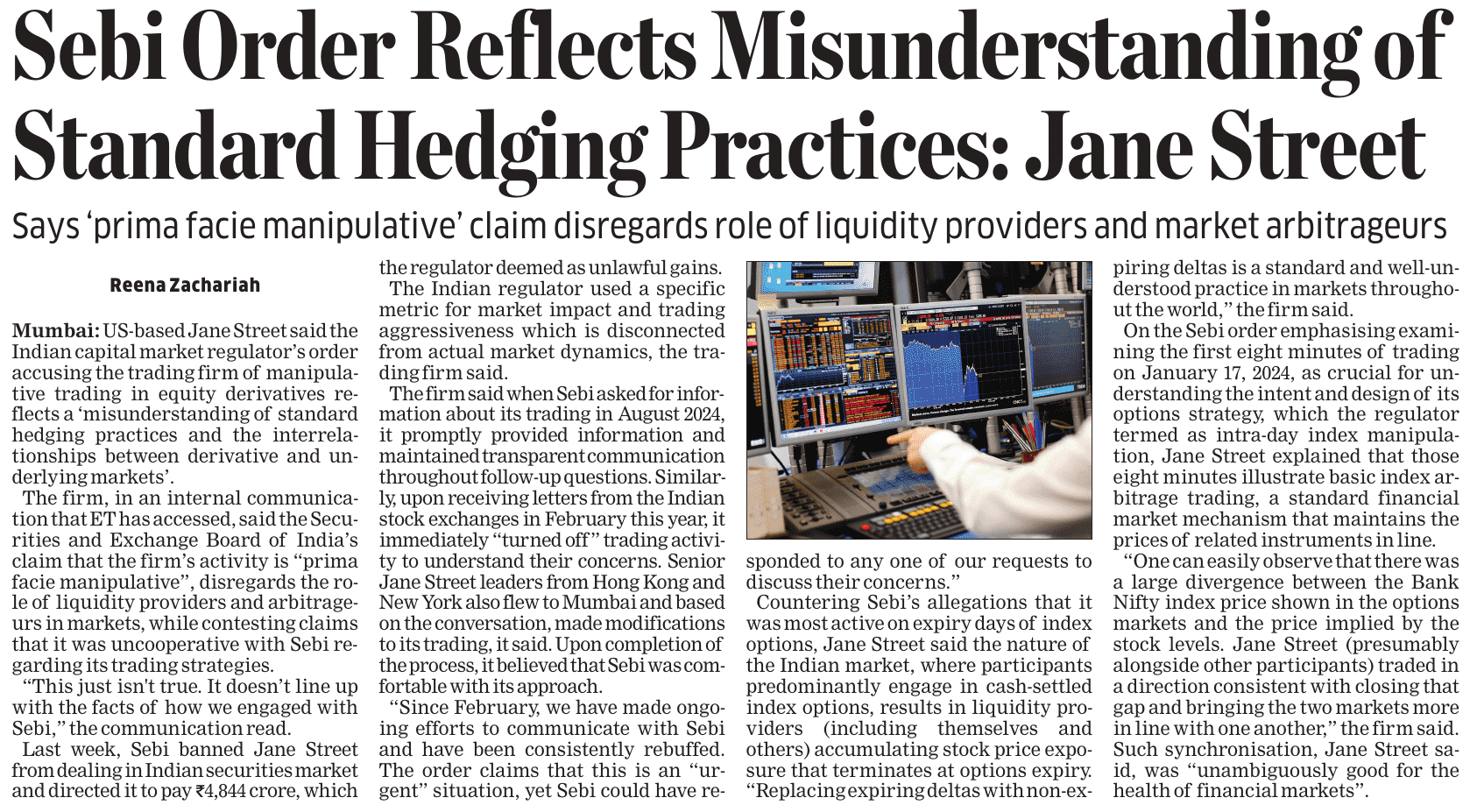
Prima facie manipulative claim disregards role of liquidity providers and market arbitrageurs.
8. Closing Notes by SKR:
Depends.
The answer to the question “Kosher Arbitrage or Unkosher Market Manipulation?” is down to whether Jane Street worked the chart as it saw it or made the chart that way aka played the hand or dealt the cards.
“Whatever the final ruling, the lesson is clear: we need to rebuild trust in trading.”
I doubt if that’s the lesson at all.
For over two years, SEBI has been warning market participants that 89% of Indian retail traders lose money, still F&O volumes in India have only gone up. That rules out trust deficit. On the contrary, punters’s trust in their own ability to outwit titans of Wall Street and Dalal Street has only risen. I’ve heard some of them say, “Oh, Jane Street Shane Street and all is only USA, it won’t work in India”.
Not sure what’s the real lesson from this scandal but it surely has nothing to do with rebuilding trust.