When an object of mass ‘m’ is struck by a force ‘F’, the object has no choice but to accelerate at F/m. So, F=ma is a natural law i.e. law about physical / inanimate objects. It is applicable to every object and at all times.
On the other hand, when the price of a product increases, some people might stop buying it, others may reduce their consumption, still others might not change their consumption. The same people may behave differently from one day to another. Laws of economics state that demand will reduce when price goes up but it’s not a natural law. While it’s empirically found to be true for the population on the aggregate, it’s not necessarily true for an individual consumer inside the population.
Would physics be a science if Newton’s laws of gravity applied only to the orchard on the aggregate and not necessarily to every apple in the orchard? That’s how Economics works.
Does that make economics less of a science or more of a science?
I don’t know.
What I do know is that econometrics, the course I studied in my MBA, was arguably the most complex subject in my academic career.
I remember that my professors in 11th standard (FYJC) used to say that statistics and induction method was not as scientific as algebra, calculus, and other types of mathematics. This is probably because they also make conclusions that are valid at the aggregate level but not necessarily to every member of the population.
3/8 Causation Maxis act Holier Than Thou as though they’re rigorous compared to correlationistas but their playbook is no less expedient. Take your statement “This borrower is risky because income is likely to decline due to sudden unemployment” for example.
— GTM360 (@GTM360) August 23, 2025
This also reminds me of probability theory. The probability of a coin turning up heads is 0.5. However, that’s the result of multiple tosses of an unloaded coin and not true for an individual toss.
Then the question arises of how much information is sufficient information.
In business, complete information is impossible. As Jeff Bezos once said, “most decisions should be made with 70% of all available information”.
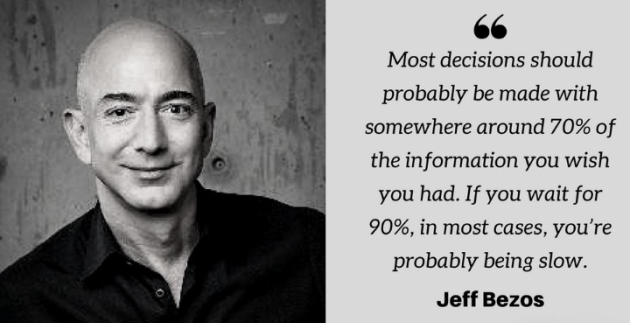
The business playbook is not to wait for 100% information in the pursuit of being 100% right. As Matt Levine said, “Algorithmic trading firms mint billionaires by being right 51% of the time”. No one bats a thousand, as they say.
Even consumers behave similarly. According to Daniel Kahneman Principle, “Consumers make do with what they know”.
“We make do with what we know” ~ Daniel Kahneman Principle.
When consumer shows bias for action and punts based on correlation, why would marketing / business wait for causation and risk losing the opportunity surfaced by correlation? pic.twitter.com/NEWehHLRsB— SKR (@s_ketharaman) March 31, 2024
I used to think that acting on incomplete information happens only in economics, marketing, business and other fields that involve human beings. But, it seems to be case even in rocket science.
“In reality, not all sensors can or should be checked all of the time. We must let go of the notion of comprehensive monitoring” ~ https://t.co/6KVYXbPtEi via CalTech JPL.
Science realizes what Business has known all along: You can’t gather all available evidence.
— SKR (@s_ketharaman) December 9, 2020