On a recent trip to Bangalore, I got a chance to use the city’s metro network. I did three trips on Namma Metro:
Trip 1: MG Road to Peenya
- MG Road to Majestic: Purple Line
- Majestic to Peenya: Green Line
with interchange at Majestic (aka Nadaprabhu Kempegowda Station).
Trip 2: MG Road to Indiranagar
- MG Road to Indiranagar: Purple Line
Trip 3: South End Circle to MG Road
- South End Circle to Majestic: Green Line
- Majestic to MG Road: Purple Line
with interchange at Majestic.
Here are my observations from these three trips:
1. Signage
Namma Metro has excellent signage. I navigated all the three trips, including the interchanges, by simply following the signs. I didn’t need to ask anyone for directions. On the other hand, a couple of others asked me for directions. Had they known that it was my first time on Namma Metro, I’m guessing they’d have gone to somebody else!
2. No Visual Signs
There’s no visual signage of route map and upcoming stations inside the train. (See Update 1 at the end of the post.) You need to pay attention to the audio announcements when they’re made.
3. No Hindi
The in-train audio announcements are only in English and the local language Kannada. I was surprised that there was no announcement in Hindi.
4. Appearance
Stations and trains both look old. Namma Metro is not as plush as Pune Metro or Mumbai Metro. But, to be fair, Namma Metro is way older than the metro networks of Pune and Mumbai. The Purple Line was operational even on my last trip to Bangalore 10 years ago.
5. Underground Side Platform
From my experience on Pune Metro and Mumbai Metro, I’d inferred that underground stations have island platform layout and overground stations have side platform layout. See Pune Metro Year 3 Impressions for details.
This is not true in Namma Metro. Majestic Station is underground but has a side platform layout. (So do overground stations like MG Road, Indiranagar and Peenya.)
6. Refreshing QR code!
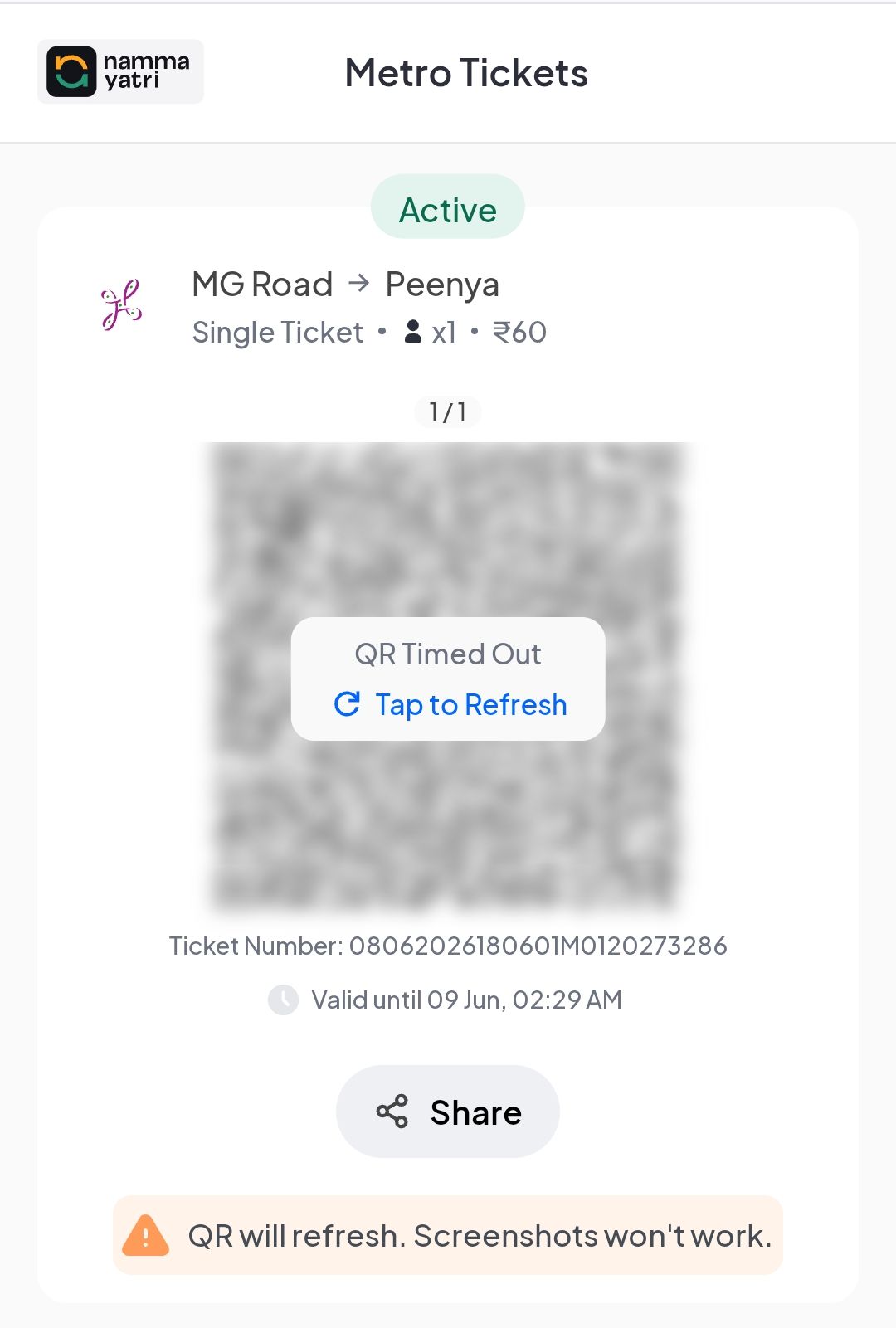 On my first trip, I followed the “Book Ticket” button on Google Maps to book my ticket before leaving my hotel. The booking process was frictionless. However, the e-ticket screen on which the QR code was displayed was not on Google Maps. There was no address bar on top, so I couldn’t figure out where exactly the e-ticket was. I was wondering how I’d retrieve the QR code at the turnstiles when I got to the station later.
For Pune Metro, I’d given a ProTip to take a screenshot of the e-ticket screen and subsequently access the QR code from the Gallery app on the phone. Unfortunately, this hack won’t work in Bangalore – the ticket states that the QR code will refresh and that screenshot won’t work.
I then noticed a “Share” button on the e-ticket screen. I tapped it and shared the ticket with my WhatsApp. I did see a URL in the chat. When I tapped it, it took me to a website via Chrome Browser. I bookmarked this page and tapped it whenever I reached a turnstile. The e-ticket page opened and refreshed the QR code automatically. Problem solved!
On my second trip, I purchased a token at the station. I tapped the token on the turnstile of the starting station and dropped it on the turnstile of the destination station. This worked without a glitch! This was similar to the ticketing system on Mumbai Metro Line 1 between Versova and Ghatkopar, which I’d taken over 10 years ago.
On my third trip, I booked the ticket via Uber app. The e-ticket with the QR code was saved in the Metro section of the app, and I could access it via my Uber app whenever I reached a turnstile. (Weeks later, the e-ticket is still there in Uber.)
7. Turnstile box
On Pune Metro, I always wonder where exactly on the turnstile I need to place my phone, paper ticket or prepaid card for them to be scanned correctly. There’s no such confusion on Namma Metro – it features a box protruding above the scanner. You simply align your phone with the box and it gets scanned right first time.
8. No Platform Screen Doors
Majestic, the only underground station I visited, didn’t have Platform Screen Doors.
For the uninitiated, PSD is a physical barrier between the train and the platform. It opens and closes in sync with train doors to allow safe boarding and alighting. Made of acrylic panels, it prevents falls onto the tracks, improves air conditioning efficiency, and reduces litter and debris on the tracks. All underground stations of Pune Metro and Mumbai Metro are fitted with PSDs.
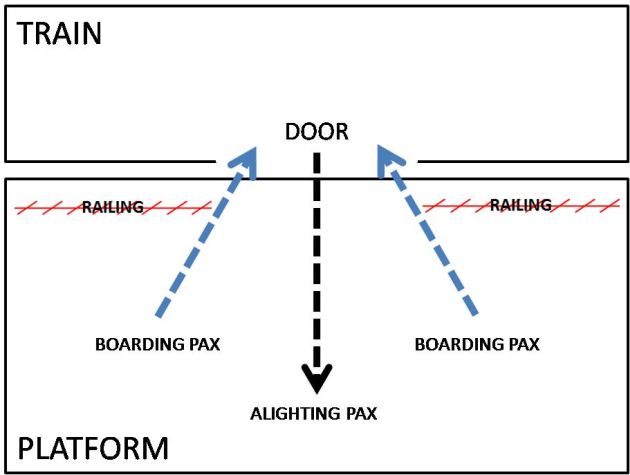
Instead of PSDs, there were railings at the edge of the platform. In between the railings, there was a gap aligned with the door of the coach, as as shown in the following exhibit. All overground stations I visited also had the same railings.
9. Crowd management
Namma Metro had excellent crowd management. As shown in the above exhibit, passengers alighting the train came out from the center of the door and passengers boarding the train lined up on either side of the door. There were security personnel enforcing the alighting and boarding discipline.
10. One Nation One Card
I’d read about a “One Nation One Card” that can be used across all metros in India. At the time, it worked on Mumbai and Bangalore metros. On my next trip to Mumbai, I tried to buy this card. While there was a popup counter for this card at Cuffe Parade station, it was unmanned.
I then heard from a Bangalore-based relative that the card was available in Namma Metro. However, I couldn’t find it at the MG Road metro station.
So my attempt to buy the One Nation One Card remains unsuccessful.
On the whole, I had a great experience with Namma Metro. I’d strongly recommend it to anyone who lives or visits Bengaluru.
UPDATE-1 DATED 19 JULY 2026
A couple of Bangalore residents messaged me that Bangalore Metro trains do have visual signs for upcoming stations.