Even though software products have been around for over 30 years, there’s one basic fact of the industry that’s still not widely understood:
Software is licensed, not owned.
The IP of software always belongs to the vendor. It is not transferred to the customer even after full payment is received. This is true as much for AI as for ERP, CRM, CBS, and all other types of software; and for both onprem / COTS software and cloud / SAAS software. (see footnote 1)
In this respect, software is different from other products which are sold by the manufacturer and owned by the customer e.g. automobile, furniture, laptop, etc. (see footnote 2).
Lack of understanding of this fundamental fact of the software industry causes all kinds of FUD about software vendors.
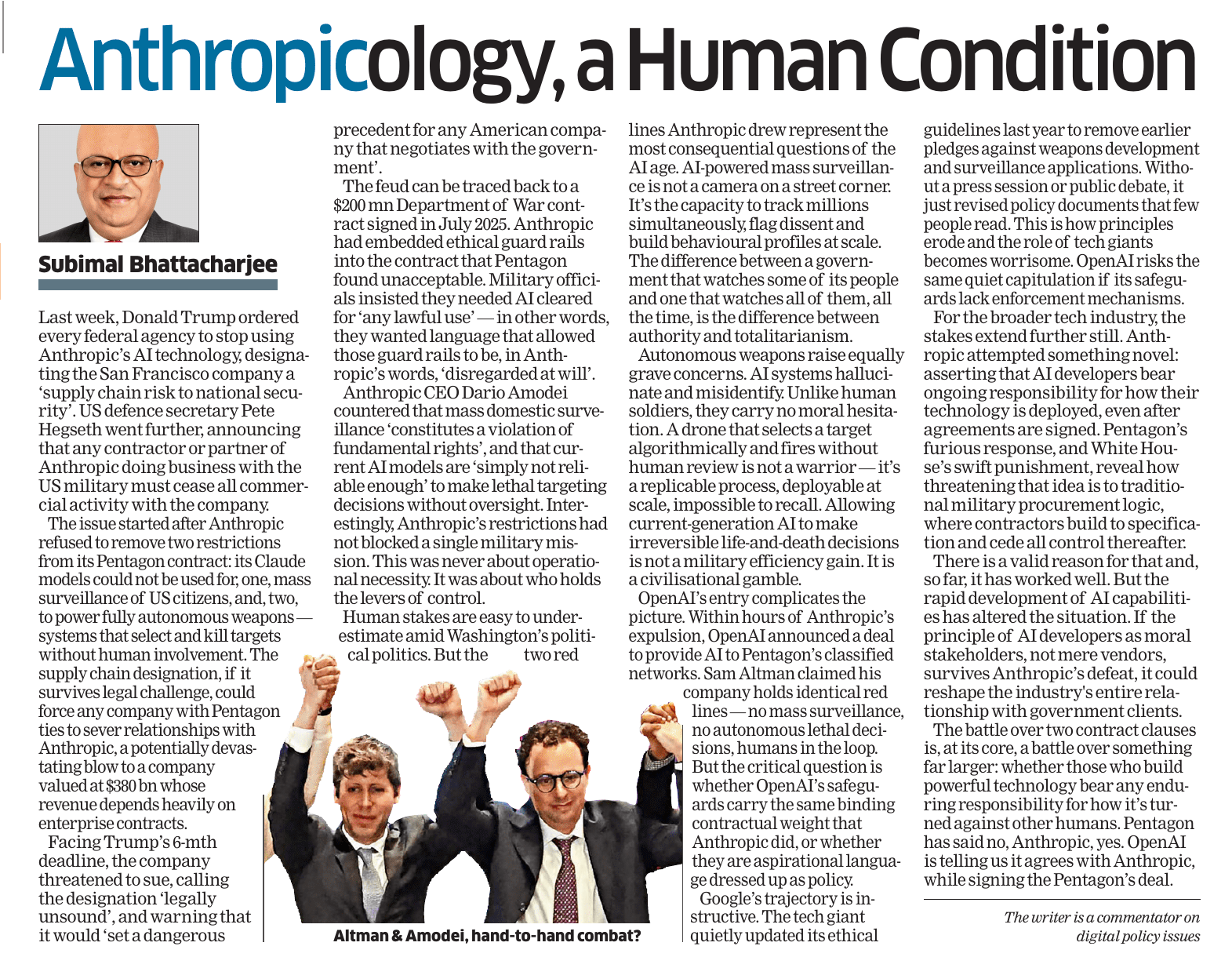
For example, take the article entitled Anthropicology, a Human Condition by Subimal Bhattacharjee in Economic Times dated 4 March 2026 (see footnote 3).
Founded on a flawed premise regarding software ownership, this article makes many wrong claims.
In this blog post, I’ll rebut them one by one.
Let’s get on with it.
Claim #1: Anthropic is bearing “ongoing responsibility for how its technology is deployed”.
Truth: Anthropic is only stipulating how its software should be used. There’s no evidence that it’s bearing any ongoing responsibility for how its customers deploy its software.
Claim #2: Anthropic is “attempting something novel”.
Truth: No. Anthropic has provided Do’s and Don’ts of how its customers should use its products, just like all software vendors do. If customers egregiously abuse the TOS of the software, software vendors pull the plug – even after they have collected full payment for it (see footnote 4). Anthropic is not the first or the only software vendor to do this.
Take Microsoft, for instance. Microsoft’s TOS stipulates that customers of Azure cannot use the cloud platform for conducting mass surveillance. At the same time, Microsoft follows the practice of not snooping on what customers use Azure for in actual practice. This could lead to a situation where a customer violates the TOS but Microsoft doesn’t know about it. This is exactly what happened when Unit 8200 of Israel Defence Force used Azure for mass surveillance of Palestinians in Gaza but Microsoft (apparently) never knew about it since it (apparently) didn’t check what IDF was using its cloud platform for. Eventually, IDF’s egregious breach of Microsoft Azure TOS was exposed by The Guardian in an investigative piece entitled “A million calls an hour’: Israel relying on Microsoft cloud for expansive surveillance of Palestinians“. Microsoft quickly shut IDF’s access to Azure soon after the article was published.
It’s not only Microsoft. Many other software vendors brick their software for violation of their TOS e.g. Salesforce – Backpage – Sex Trafficking, Substack, WordPress.
Hey @wordpressdotcom, why has my blog been taken down? And sans intimation? (And what terms of service did I violate? All I do here is aggregate links to my journalism)
PS: Folks, their contact form is not accepting my complaint either. Could you amplify this message please? pic.twitter.com/EVdihab7zf
— m rajshekhar (@mrajshekhar) March 24, 2026
Claim #3: AI developers are “moral stakeholders, not mere vendors”.
Truth: Software vendors have always controlled how their software is used but they have rarely, if ever, taken moral responsibility.
Claim #4: Contractors build to specifications and cede all control thereafter to the customer in military procurement.
Truth: This is not true for COTS or SAAS software. It’s only true for bespoke aka custom-developed solutions – for both military and non-military procurement. Even corporate and SME customers own the source code of bespoke solutions and have full control over its ongoing usage.

Claim #5: “Do those who build powerful technology bear enduring responsibility for how it’s turned against other humans? Pentagon has said no, Anthropic, yes.”.
Truth: This is highly questionable. If Pentagon faces a problem with some feature of Anthropic, I’m sure it will invoke product defect or some other clause of the contract to penalize Anthropic. So, Pentagon is not absolving the vendor of responsibility. It’s only arguing that the vendor should not dictate how it should use its software. They’re not the same.
It’s no longer only software.
The practice of manufacturers exerting control over the ongoing use of their products is rapidly spreading to many other product categories such as smart devices. Stories abound that printers stop printing if customers install a “duplicate” – aka not from OEM – ink cartridge, refrigerators shut down if consumers use a third-party filter, cars get bricked if the owner falls behind on loan repayments.
Then there are restrictions that also apply to OEMs.
Several years ago, engineers at a major Indian OEM wanted to add a simple valve to their own engine.
They knew how to do it. The problem: the software running inside their own vehicle’s ECU was locked. The key was in Germany.
Three years later, the problem remained unsolved. ?
— Swarajya (@SwarajyaMag) March 23, 2026
Contrary to what the author of the aforementioned article believes, this is not a brave new world – software product vendors and customers have inhabited this world since the dawn of the software industry!
FOOTNOTE(S):
- When software vendors say they “sell software”, what they really mean is that they sell the license of the software.
- A lot of land in Bombay nka Mumbai is not owned – it’s on a 99-year lease from the local government. Click here for the details.
- In case the aforementioned op-ed entitled Anthropicology, a Human Condition in Economic Times is paywalled, cf. the following exhibit.
- Some vendors might refund a part of the payment but they’re rare.