I recently went from Kalyani Nagar to Nashik Phata via Pune Metro. My route was:
- Kalyani Nagar to District Court (fka Civil Court) on Aqua Line towards Vanaz.
- District Court to Nashik Phata on Purple Line towards PCMC.
Here are a few updates on the metro from this trip:
1. Crowds
Both Aqua and Purple lines were packed. This was during nonrush hours. Seems like Puneites have upped their public transport mojo during this past year!
2. Station buzz
Stores have started opening in metro stations. I saw flea markets, coffee shops, and vada pav stalls at District Court and Pune Railway Station stations. They were on either side of the ticket turnstile.
3. Interchange pain
Daunted by the interchange, many people I know – including me – have shied away from traveling between Aqua and Purple line stations. During this trip, I timed myself and it took just six minutes to go from the Aqua Line to the Purple Line platforms at District Court. I think the interchange pain is exaggerated.
4. Intrain announcement
As I was approaching RTO station, the intrain announcement said “RTO Pune Station”. Now, RTO and Pune Station are adjacent stations on Aqua Line. So this could be confusing – is the next stop RTO or Pune Station?
It it struck me that there are many RTOs in Pune (e.g. this one at Sangamwadi, another one at Vishrantwadi where there’s no metro, etc.) The announcer probably said RTO Pune Station to be clear about which RTO she was referring to. While this is factually correct, it’s poor UX since there’s a good chance that a first time metro rider will get more confused between two successive metro stations than various RTOs.
It’s easy to fix this problem by changing the annoucement to “RTO Sangamwadi”.
5. Bearing loss
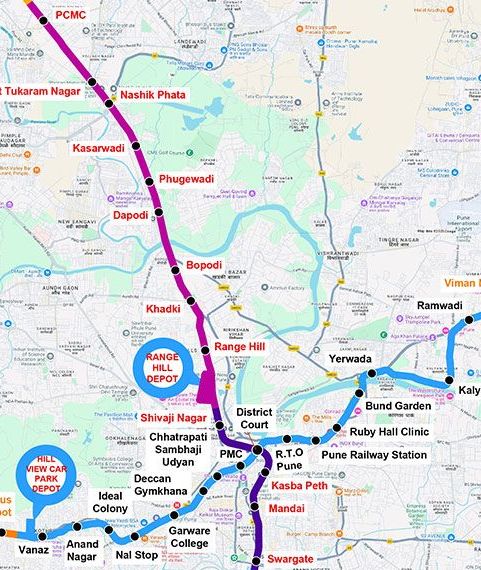
I got off at Nashik Phata station on Purple Line. I wanted to saunter around the neighborhood and walk up to Kasarwadi, the previous station, then board the metro back to District Court (see Pune Metro Route Map in the above exhibit). I got my bearings wrong and walked in the opposite direction to reach the next station Sant Thukaram Nagar!
Had I bought a normal ticket for the trip, I’d have had to buy another ticket. But, thankfully, I’ve the Pune Metro Prepaid Card. Being tap-on/tap-off, I can get in anywhere without any hassles.
My wife, who is quite familiar with my poor sense of bearing quipped, “Thank God, you chose not to get off at PCMC station to saunter around”. Had I walked from PCMC station in the wrong direction, I wouldn’t have ever come across the “next station” because PCMC is the terminal station and there is NO next station after it!
On a side note, the footpath outside Nashik Phata was dug up, so it was painful to saunter around the neighborhood (not that I’m offering this as an excuse for getting my bearing wrong!).
6. Door opening direction
At all stations on the Aqua Line, the doors opened on the left of the travel direction. On the Purple Line from District Court station, I found that the doors opened on the right side at the next station (Shivaji Nagar). I then recalled that they’d opened on the RHS even at District Court.
I was wondering if the door opening thing worked differently in Purple Line as compared to Aqua Line. But, from the very next station (Khadki) onwards, doors opened on the left at all subsequent stations.
To summarize, all stations on Aqua Line opened on the LHS; some stations on Purple Line opened on the RHS and the others, on LHS.
I quickly spotted the correlation between door opening direction and the station level.
- Aqua Line is entirely overground. Doors opened on the LHS on all stations of this line.
- Purple Line is underground between Swargate and Shivaji Nagar via District Court and overground between Shivaji Nagar and PCMC via Khadki sections. Doors opened on the RHS at underground stations and the LHS at overground stations.
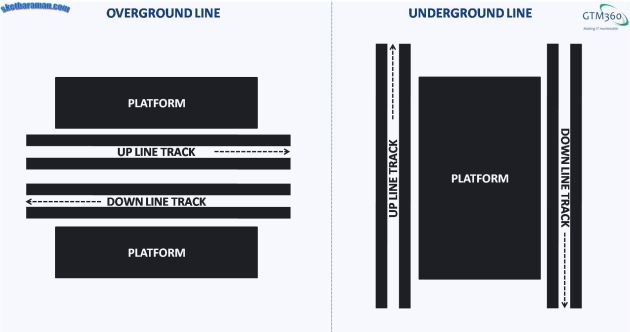
I also noticed that, in the overground stations, the up and down tracks are adjacent to each other with the two platforms being separated by the tracks i.e. the layout is Platform-Track-Track-Platform, as shown in the following exhibit.
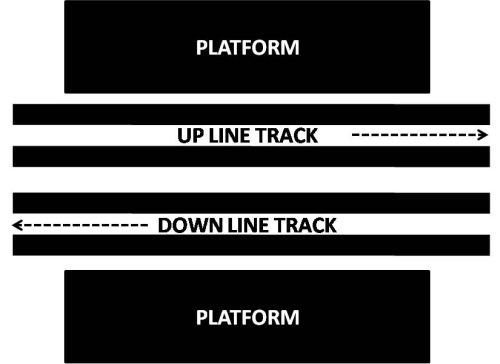
As I learned later, this is called “Side Platform” layout.
Whereas, in the the underground stations, I noticed that the up and down platforms are adjacent to each other with the two tracks being separated by the platform(s) i.e. the layout is Track-Platform-Platform-Track, as shown in the following exhibit.
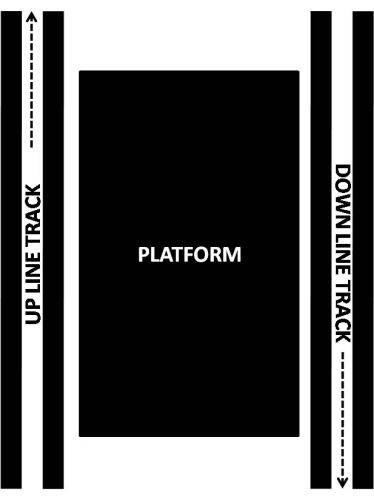
This is called “Island Platform” layout.
I was curious to know if the correlation between door opening direction and the station level that I observed was just that – a correlation – or caused by civil engineering and / or architectural best practices.
To find out more, I reached to two friends, Jagdeep Desai, an architect, and a civil engineer who’d like to go unnamed. Neither was 100% sure but they felt this was fairly universal design and not by chance. This is what I learned from them:
Road tunnels are never two way. This is because air currents in closed spaces can cause skidding. This risk is heightened in the case of metro trains since they’re run on tracks and will derail if they skid even slightly. Therefore the tunnel for up line track will need to be put in one tube and that for down line track in another tube. The separation between the two tracks gives enough space at station to have island-type platform that is wide enough to accomodate up and down lines. Therefore, platforms are adjacent to each other in an underground station.
On the other hand, viaducts for overground tracks are made above ground and are inevitably built on existing roads with buildings along both sides. The greater space required in the underground layout may not always be available overground. Therefore, in the case of overground tracks, it makes sense to put the up and down line tracks next to each other, so that the viaduct can be kept as narrow as possible. This layout does not carry the risk of skids and derailment since the viaduct is open and air currents are not very strong. This means there isn’t enough space between the two tracks at station to accommodate island type platform between the up and down lines. Therefore, platforms are not adjacent to each other in an overground station.
ChatGPT gave another reason for underground lines to be unidirectional: Tunnel Boring Machines can bore only one tube at a time.
7. Station names
Many stations on Pune Metro have corporate sponsors e.g. Kalyaninagar – Cybage, Yerwada – Bajaj General Insurance (fka BajajAllianz General Insurance). But the sponsor’s name is not a part of the station’s name, which are simply Kalyaninagar and Yerwada.
But there’s one exception: Ruby Hall Clinic, a private sector hospital. Not sure how it got a station (on the Aqua Line) named after itself.
8. Exit walkway
I recently met a coworker at Fergusson College Road. While there’s no metro stop at FC Road, Google Maps told me that it’s just a 10 minute walk from Deccan Gymkhana station on the Aqua Line, so I decided to take the metro. According to the route map, I’d have to cross Jangli Maharaj Road. Being a major artery of Pune, JM Road is always busy with vehicular traffic. Being a one way road with four lanes, JM Road is notorious for being nightmarishly difficult to cross on foot.
When I alighted from the metro at Deccan Gymkhana station, I saw a long exit walkway. When it reached JM Road, I was pleasantly surprised to find that it went over JM Road, thereby obviating the need for me to brave the traffic at the road level.
I felt this design is very well thought-through. Special shout out to Pune Metro.
9. Track crossing
Suppose a passenger wishes to travel from Kalyaninagar to District Court. She’d need to take the Aqua Line towards Vanaz.
After crossing the ticket turnstile at Kalyaninagar station, suppose she takes the first concourse elevator to the platform level. She might land up on the (wrong) down line platform towards Ramwadi. She’d need to go back down the concourse elevator to the ticket level, cross over to the concourse elevator on the other side, take the elevator up to the platform level and reach the (right) platform of the up line towards Vanaz.
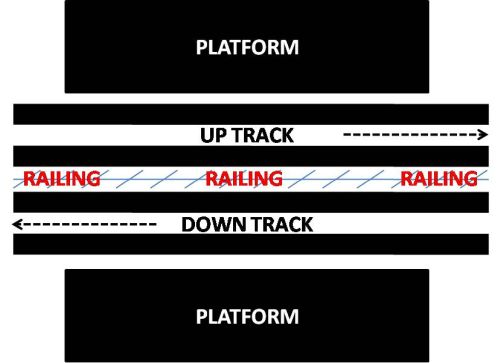
Seeing that the tracks are adjacent to each other at this overground station, she might be tempted to take a shortcut by crossing the tracks at the platform level. This is obviously dangerous due to oncoming trains and high tension electric cables. There are signs all over the station saying crossing the tracks is an offence. Despite that, if the crossing tracks problem doesn’t go away, the metro operator might want to block passengers from crossing tracks by putting a railing between the two tracks, as illustrated in the following exhibit. (Note that track crossing is only a problem at overground stations due to side-platform design. Island-platforms at underground stations specifically let passengers take trains on either up or down line without crossing tracks.)
When it instructs the metro contractor accordingly, the contractor would treat this as a change request and ask for money to execute it.
In a simple world, the metro operator would approve the paid CR.
But, suppose the construction contract has a clause related to safety to the following effect: “The contractor shall take steps to ensure utmost safety of the station”. In that case, the metro operator can always pushback on the metro contractor that, as a safety measure, the railing should have been included in the basic scope of supply and reject the the paid CR.
Seasoned contractors will not accept such an omnibus clause in the first place but there could be software companies seasoned at developing software but not seasoned at negotiating contracts who might accept such a sweeping clause in their contracts, only to find out later that a fixed price project that was supposed to be profitable suddenly becomes a loss-making one. Click here to know how you can guard yourselves from such lethal gotchas in software development contracts.
Going by my data point of this one trip, teething troubles in Pune Metro related to ticketing, prepaid card, and network coverage seem to be resolved. Last mile connectivity from metro stations have improved and / or public transport mindset among Puneites has gone to the next level (or both).
Three years after commencing operations, Pune Metro is rocking!
RELATED POSTS:
- Pune Metro First Impressions
- Pune Metro Second Impressions
- Pune Metro Third Impressions
- Pune Metro Card – Third Time’s The Charm