Marketers are familiar with cost-plus and value-based pricing models, which are the two most commonly used methods for pricing products and services.
"What The Traffic Can Bear Pricing". Everyone understands "cost plus" pricing. Many understand "value based" pricing. But very few people (in my circle) understand that some brands can get away with exorbitant prices just because their target audience doesn't feel the pinch.
— Ketharaman Swaminathan (@s_ketharaman) May 11, 2020
In cost-plus pricing, all input costs are totalled up and a markup is applied on top to arrive at the selling price. More the number of inputs, higher the cost and, ergo, higher the price.
In value-based pricing, the selling price is set based on brand, competitor prices, perceived value of pain solved or gain created, and many other factors that are not linked to inputs / input costs.
Any given item in the market from a given company will have a price that is either based on cost-plus or value-based pricing model. This makes a direct comparison of the two prices impossible. But, as a general rule of thumb,
- Unbranded products will follow cost-plus pricing, and branded products will follow value-based pricing.
- Value-based price will be higher than if the price were dictated by costs alone.
In addition, most people intuitively believe that cost-plus and value-based prices for a given brand will be directionally identical. In other words, if a given brand has two products A and B, B will have a higher selling price than A if B has more inputs than A.
This belief is taken as true on faith.
But it turned out to be false when we recently stumbled on to some opportunities to put it to test.
#1. PANASONIC
Panasonic recently launched a new model of desk phone called KX-TSC62SX. Readers would be aware that feature-rich handsets generally need batteries and a charger to charge the batteries, as a result of which they need to be plugged in to the mains at all times. Unlike its older brethren, the KX-TSC62SX doesn’t use any batteries.
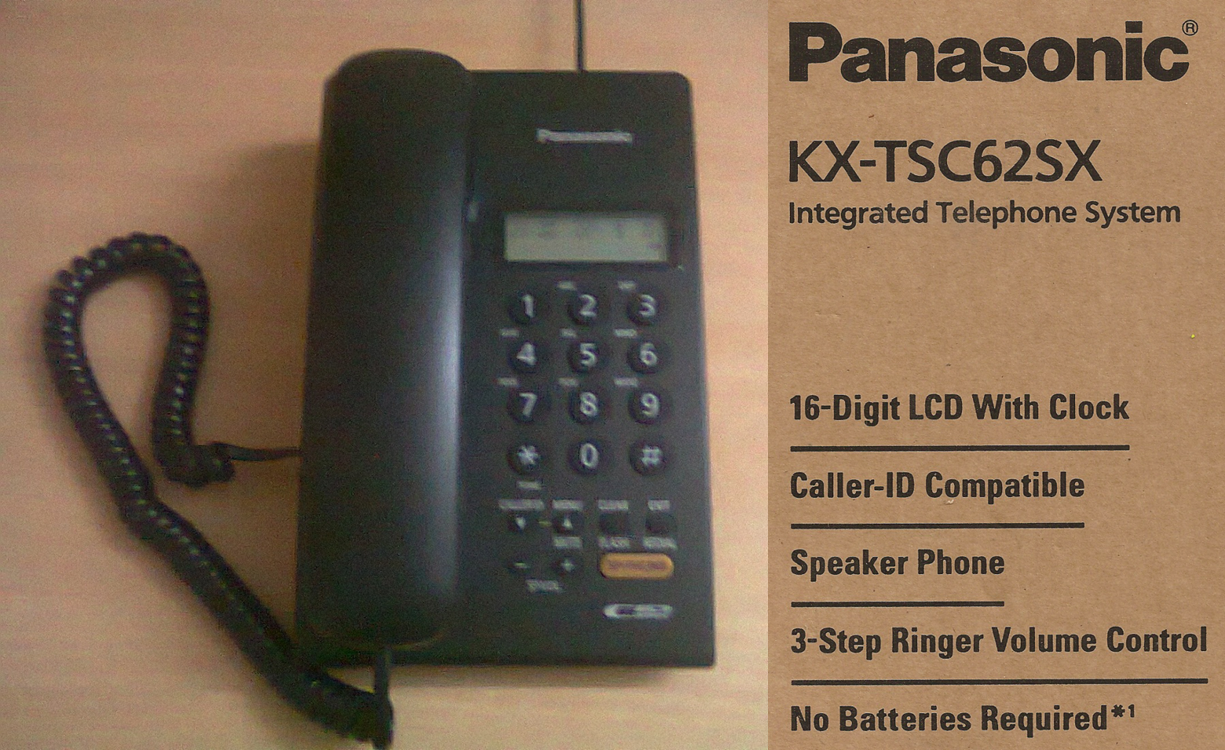
No batteries means no charger, therefore KX-TSC62SX has a lighter bill of material compared to previous models of Panasonic phones that require batteries and / or charger. According to cost-plus pricing, this model should be cheaper than other models.
At the same time, lack of batteries means no need to plug a KX-TSC62SX to the mains. As a result, KX-TSC62SX alleviates the pain inherent with conventional phones of having to cart around one more wire and be tethered to a power socket. According to value-based pricing, this model should be costlier than other models.
Ergo tussle between the two pricing models.
#2. WADESHWAR
Take the following two items in the menu of this iconic restaurant in Pune, India.
- Tea
- Tea (without sugar)
Obviously, the second item has fewer inputs than the first item. According to cost-plus pricing, it should be cheaper than the first item. But sugar is supposed to cause all kinds of health problems, so the second item that does not have sugar has a greater perceived value than the first item. Therefore, according to value-based pricing, it should be costlier than the first item.
Wadeshwar breaks the tussle between the two pricing methods by opting for value-based pricing, as you can see from the following prices:
Tea: INR 33.00
Tea (without sugar): INR 38.00
Nice example of "value-based pricing" from @wadeshwar – under "cost-plus pricing", "Tea with Sugar" would have a higher price than "Tea (without sugar)". https://t.co/nG6UjOkDkY pic.twitter.com/7PmEpT02nC
— GTM360 (@GTM360) January 19, 2018
Now, let’s come to the third and comparatively less-understood pricing method: What The Traffic Can Bear.
In this method, prices are way above what’s dictated by value-based pricing.
In value-based pricing, prices are percentage more than competing products e.g. iPhone costing 30-50% more than a Samsung smartphone.
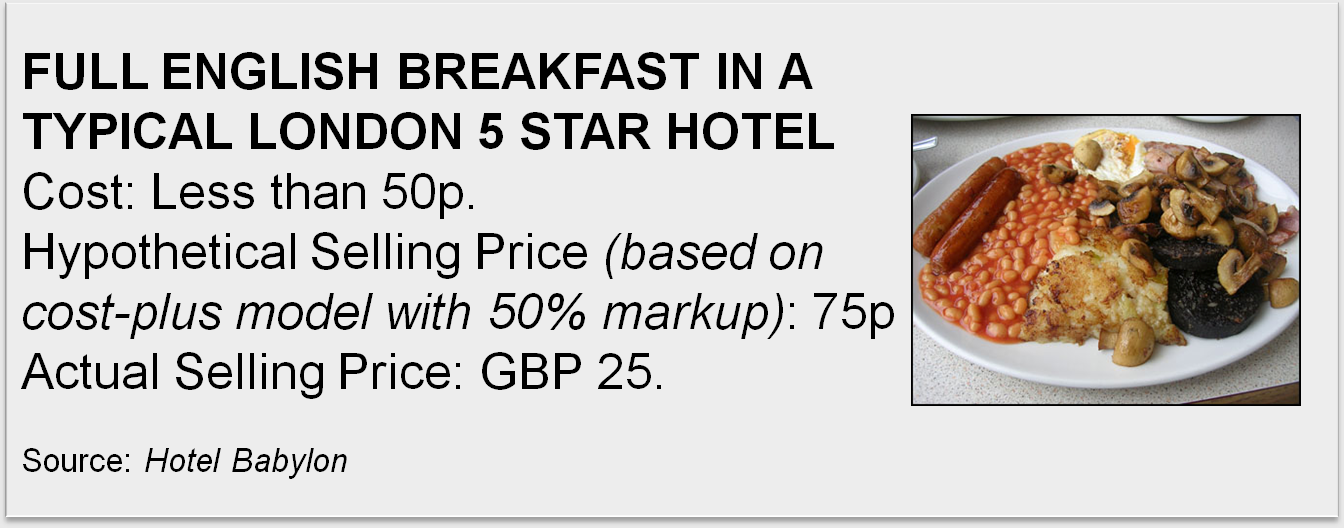
In What The Traffic Can Bear pricing, prices are times more than competing products. This model is typically used for luxury goods with status symbol / snob appeal. Brands are able to get away with exorbitant prices in this product category just because their target audience doesn’t feel the pinch e.g. Prada bags, Patek Philippe watches, Full English Breakfast in a typical London five star hotel.
As you can see from the following exhibit, the input cost of the said English Breakfast is less than GBP 1 whereas its selling price is GBP 25.
H/T to Hotel Babylon, a book by Imogen Edwards-Jones and Anonymous about the luxury hotel industry in London, for this example.
I recently came across a rather weird case of pricing.
Clinic Plus Shampoo:
- 650 ml bottle: INR 325
- 6 ml satchet: INR 1
H/T to our customer Anshuman Shrivastava, Director Toptier Energy Services and ex-Banker, for this example.
The Unit Price works out to the following:
- 650 ml bottle: INR 0.50 per ml
- 6 ml satchet: INR 0.17 per ml
In other words, the satchet is 3X cheaper than the bottle on unit price.
I’m guessing that the brand is seeking to expand the market for shampoo in a poor country by introducing a satchet that is targeted at the “bottom of pyramid” market where the affordability is very low compared to that of the bottle’s target audience comprising affluent people.
If I’m right, this should be called What The Traffic Can’t Bear pricing model.
Interesting post. What you didn’t point out is that customers (B2B or B2C) don’t care about what it costs to produce a product or service, but they do care about the value they receive. Yet 70% – 80% of companies still use cost-plus pricing.
At PricingProphets.com, the worlds only crowdsourcing platform devoted to pricing, our experts only provide recommendations based on value-based pricing.
@Pricing Prophets:
Thank you for comment. We don’t subscribe to the view that buyers don’t care about costs.
Maybe it’s a cultural thing and varies from country to country, but we know lots of people in both B2B and B2C who keep doing back-of-the-envelope calculations of what something should cost and then assess whether the quoted price is fair or tantamount to scalping. It’s another matter as to how qualified such people are in making such calculations, and who determines what’s fair and what’s not, and so forth, but point is, these are potential buyers and they follow such practices.
We believe that companies like iSuppli that provide detailed bill-of-material and manufacturing costs of various products (e.g. iPad2) will reinforce this practice. Furthermore, not all buyers believe themselves to be capable of assessing the value of what they’re about to buy before buying and using it for a certain period.
While I agree with PricingProphets that people don’t generally care about your costs, I think they do if a). your prices are so low relative to costs (known or perceived) that you may go out of business or b). perceptions of the offering (not just the product) haven’t been managed so people see/understand the value.
The GBP25 breakfast is a good example. To the hotel guest, a person on an expense account, or someone who is meeting a client, the price may be just fine — in line with the price of a 5 star hotel.
People who are price sensitive would probably look at the bill of materials and decide the price was too high. They might look at the surrounding, the qualifications of the chef, the service, etc. and value all of these elements as nil.
These same people might view the same breakfast for GBP1 or 2.50 as fair since they didn’t have to cook the meal or clean up. (If they were really price sensitive and didn’t place a value on their time, they would likely only buy the ingredients — at a high price shop.)
What this boils down to is the need to manage a customer’s perception of both the value and the costs — a task that can be very difficult.
@9618a94cb29aeaa2c058208c4cc01ce8:disqus:
Thank you for your comments. We fully agree that it can be very challenging to simultaneously manage a customer’s perception around cost and value.
I agree with Pricing Prophets. As an example, may I quote a story about my own business.
I don’t have an hourly or daily rate because I set my prices purely based on the value the customers tell me – before work ever starts – that they will derive from the results I produce.
Once I went back and calculated my hourly rate, mainly because it would create a good story. The best hourly rate I have ever worked for is £6,000 per hour, yes per hour!
The customer and I agreed the value of the result and the price – £500 – for producing it. The customer happily paid me the price and I delivered a totally acceptable result well within the desired timescale. The delighted customer neither knew nor cared how little time – 5 minutes – it had taken me.
Managing perception of value is not difficult at all because it just never needs to be done.
Value can only ever be in the eye of the beholder, so the customer has to tell you how much value they will derive.
Often they will need help to understand value. This is not difficult either. It is a skill that is rarely innate but it can easily be learned by most people.
Pingback: Even If Customers Don’t Bother About Costs, Regulators Do | GTM360 Blog
Pingback: Even If Customers Don’t Bother About Costs, Regulators Do « Talk of Many Things